

Study BISMA Fitness Courses Online from Outside the UK (Level 2 Gym Instructor & Level 3 Personal Trainer)
Interested in becoming a gym instructor or personal trainer while living outside the UK? BISMA welcomes enquiries from international learners for its online Level 2 Gym Instructing and Level 3 Personal Training courses. You can access your learning materials from abroad and, where the assessment arrangements for your qualification have been confirmed, submit your work remotely.
Before enrolling, tell us which country you live in and where you plan to work. We can explain the course and its assessment requirements, while you check the qualification and registration requirements in your chosen country.
Which course should I choose?
The Level 2 Gym Instructing course is designed for people who want to learn to plan, instruct and supervise gym based exercise. The Level 3 Personal Training course develops the knowledge and practical skills needed to plan and deliver personal training. If you do not already hold an accepted Level 2 gym instructing qualification, ask us about our combined Level 2 and Level 3 option. Entry to Level 3 depends on meeting its qualification prerequisites.
These courses lead to UK qualifications issued by Focus Awards. Their relevance outside the UK depends on the rules of the country, professional register and employer you choose. A UK qualification alone does not automatically grant registration, employment, insurance or permission to practise abroad.
How does studying from abroad work?
Our online learner portal provides video lessons and exercise demonstrations, e-books, infographics and course guidance. You can study at your own pace and contact BISMA for support by email or WhatsApp. Joining a local gym can help you practise and prepare to film your practical assessment, but you should confirm that the gym permits filming and that you can safely access the required equipment and people.
Assessment includes written work and practical evidence. Written assignments and portfolio work can be prepared abroad and sent to admin@bisma.org for marking. For qualifications and assessment routes that permit video evidence, you may be able to record the required gym instructing or personal training session locally and submit it remotely. We will give you the current assessment brief, evidence requirements and submission instructions before you start. A local gym induction or a staff demonstration is useful for practice, but it does not replace your own assessed teaching, observation and feedback.
Please check the arrangements with BISMA before enrolling. Remote assessment depends on the specific qualification, current Focus Awards requirements and BISMA’s approved assessment arrangements. Some practical activities require a suitable gym, a participant or client, and footage that clearly shows your performance. We will confirm whether your chosen course can be completed without travelling to the UK.
Can I use the qualification to work internationally?
CIMSPA registration and international portability. Graduates who meet the requirements for the relevant qualification may apply to CIMSPA for professional status, such as Gym Instructor Practitioner or Personal Trainer Practitioner. BISMA can provide the exact Focus Awards qualification details to help you check eligibility. CIMSPA assesses each application; completing a BISMA course does not automatically grant CIMSPA membership.
CIMSPA operates the UK register and is a member of ICREPS, a network of national registers. Once registered with CIMSPA in the appropriate professional category, you may be able to transfer your professional registration to a participating register in another country. The available routes depend on your registration category and destination. The receiving register may ask for a letter of portability and require additional evidence or local training before accepting your application.
For work in Europe, you can also enquire about registration with EREPS, the European Register of Exercise Professionals. EREPS reviews applications against its own entry requirements. Its registration categories and European framework levels differ from UK qualification levels, so a UK Level 3 certificate does not automatically confer an EREPS Level 3 registration.
ICREPS publishes portability guidance, but does not directly register individual trainers. CIMSPA membership is a potential starting point for portability, rather than permission on its own to work in another country. Always confirm the destination register’s requirements, prospective employers’ expectations and any local right-to-work rules.
Before paying for a course, ask the relevant register and prospective employers in the country where you plan to work:
- Do you accept the exact Focus Awards qualification I plan to take? Give them the full qualification title and number.
- If I register with CIMSPA as a Gym Instructor or Personal Trainer Practitioner, is there a portability route to your register? Will I need a letter of portability or additional training?
- Are there local requirements for insurance, first aid, language, supervised experience or work authorisation?
- Will you accept a qualification assessed using remote video evidence?
Requirements differ by country and can change. Keep a copy of any written confirmation you receive.
What about BISMA’s other courses?
BISMA also offers courses in nutrition, strength and conditioning, leadership and management, and other subjects. These may be relevant to professional bodies or employers internationally, but each field has its own registration and recognition arrangements. EREPS and ICREPS routes for gym instructors and personal trainers should not be assumed to apply to every BISMA course. If you have a particular accreditation or job in mind, check the exact qualification with the relevant body before enrolling.
Why study with BISMA?
You can access structured online resources, tutor support and assessment guidance while studying abroad. BISMA’s courses are issued through Focus Awards, and our accreditations page explains our UK recognition and international professional registration pathways. Course inclusions, prices and any costs charged by external registers or employers should be checked for your chosen course before enrolment. Reassessment arrangements and any applicable fees will be set out in your course terms.
Ask us about studying from your country
Email admin@bisma.org with your country of residence, the country where you hope to work, the course you want to take and details of any Level 2 gym instructing qualification you already hold. We can confirm the current course entry and remote assessment arrangements, and provide the exact qualification details for you to check with the relevant overseas register or employer.
PS. This information was last updated on 24 September 2026. Please note that CIMSPA, EREPS and ICREPS may change their requirements, policies or procedures at any time. Learners should therefore contact the relevant organisation directly to confirm the latest information before enrolling or applying for membership or professional recognition.
Overview
This page explains the requirements in teaching exercise sessions to children aged 5 till 11 years old.
What Qualifications Do I Need to Teach Fitness to Children Aged 5 to 11 in the UK?
Teaching fitness to children aged 5 to 11 requires more than general gym experience. Children have different physical, emotional and cognitive needs from adults. An instructor must be able to plan suitable activities, communicate at the right level and maintain strong safeguarding standards.
There is no single UK law stating that every children’s fitness instructor must hold one specifically named qualification. However, instructors have a duty of care. Employers, facilities, insurers and professional bodies normally require evidence that the instructor is appropriately qualified and competent to work with children.
What qualifications are normally needed?
The appropriate route will depend on what the instructor intends to deliver.
For general children’s fitness or physical activity sessions, the instructor would normally need:
- A relevant regulated fitness, physical activity or sports coaching qualification.
- A recognised qualification for instructing physical activity to children aged 5 to 11.
- Current Safeguarding and Protecting Children training.
- Appropriate first aid training.
- A suitable background check and insurance.
If the instructor intends to work as a personal trainer, complete detailed consultations, design individual programmes and provide ongoing one to one personal training, a regulated Level 3 Personal Training qualification should normally be held in addition to the children’s qualification.
Qualifications for working with children aged 5 to 11
The children’s qualification should include planning, preparing and delivering safe and effective physical activity for primary school aged children. It should also cover child development, communication, professional boundaries and safeguarding.
Examples of qualifications that can meet or contribute towards these requirements include the following.
Level 2 Award in Instructing Physical Activity for Children
This type of qualification is specifically designed for instructors who want to plan and deliver physical activity sessions to children.
For example, the Level 2 Award in Instructing Physical Activity for Children covered the planning and delivery of safe and effective sessions for children aged 5 to 11 and young people aged 11 to 15. It also included relevant legal, professional and safeguarding requirements.
The prerequisites for this qualification requires learners entering this qualification to hold a suitable Level 2 fitness instructing qualification, such as a Level 2 Gym Instructing, Group Training or Fitness Instructing qualification.
Level 2 Award in Engaging Children and Young People in Sport and Physical Activity
The Level 2 Award in Engaging Children and Young People in Sport and Physical Activity (or equivalent), covers participants aged 5 to 18. It includes planning and delivering physical activity, engaging children and young people and safeguarding.
Although this qualification covers a wider age range, it includes children aged 5 to 11 and can therefore provide relevant evidence of competence for this group.
Other recognised qualifications
Many awarding organisations may offer regulated qualifications with similar content. The title does not always need to be identical. Before enrolling, learners should check that the qualification:
- Is current and open for registration.
- Is awarded by a recognised awarding organisation.
- Covers children aged 5 to 11.
- Includes practical assessment rather than theory alone.
- Covers planning and delivering physical activity.
- Includes safeguarding and professional practice.
- Is accepted by the intended employer, facility and insurer.
- Meets any relevant CIMSPA professional standard.
A short attendance certificate or unassessed online course may provide useful continuing professional development, but it should not automatically be treated as equivalent to a regulated and practically assessed qualification.
Is a Level 2 children’s qualification sufficient?
It depends on the role and the activity being delivered.
A suitable Level 2 children’s physical activity qualification may allow an instructor to plan and deliver age appropriate physical activity sessions within the scope of that qualification. This could include movement skills, games, circuits and general fitness activities.
However, the instructor must also meet the entry requirements and hold any underlying fitness or coaching qualification required by the awarding organisation.
If the instructor is offering a full personal training service, particularly within a gym, a Level 3 Personal Training qualification should normally be added. This supports competence in consultation, individual programme design, progression and ongoing review.
The instructor should never assume that the word “children” in a course title automatically covers every form of one to one fitness training. The qualification specification, insurer and intended workplace should always be checked.
CIMSPA Working with Children Professional Standard
The CIMSPA Working with Children Professional Standard covers children aged 5 to 18. It includes coaching children, helping them improve their fitness and delivering sport or physical activity for enjoyment.
For the 5 to 11 age group, the instructor should understand primary age child development and be able to adapt sessions to the child’s physical, social, emotional and cognitive stage.
A qualification endorsed against this standard provides useful evidence that the course reflects recognised sector expectations. CIMSPA recognition does not replace the need to check the exact scope of the qualification and the requirements of the employer or insurer.
Safeguarding and Protecting Children training
Anyone working with children should complete current safeguarding training. Safeguarding training is separate from the technical fitness qualification and should explain how to:
- Recognise possible abuse, neglect, grooming and poor practice.
- Respond appropriately to a disclosure or concern.
- Record and report concerns through the correct procedure.
- Maintain professional boundaries.
- Communicate appropriately with children, parents and carers.
- Manage photography, video, social media and electronic communication safely.
The instructor or employing organisation should also have a written safeguarding and child protection policy, a named safeguarding contact and a clear reporting procedure.
DBS, PVG or AccessNI checks
A background check is not a fitness qualification, but it is an important safeguarding measure.
The relevant system depends on where the instructor works:
- In England and Wales, checks are provided by the Disclosure and Barring Service, commonly known as DBS.
- In Scotland, the relevant system is the Protecting Vulnerable Groups scheme, commonly known as PVG.
- In Northern Ireland, the relevant system is AccessNI.
In England and Wales, a role involving regular teaching, training, instruction or supervision of children may be eligible for an Enhanced DBS check. Depending on the nature and frequency of the work, it may also be eligible for a check of the Children’s Barred List.
Self employed instructors in England and Wales can apply for an eligible Enhanced DBS check through a registered DBS Umbrella Body. If the instructor works for a gym, school, club or another organisation, that organisation may arrange the check.
The correct checking body or organisation should confirm the appropriate level. A Basic DBS check is not the same as an Enhanced check for work within the child workforce.
First aid requirements
The instructor should hold current first aid training appropriate to the environment and the age of the participants. Paediatric first aid is a particularly strong choice for anyone regularly working with children aged 5 to 11.
The instructor should know how to respond if a child becomes ill or injured, how to contact the parent or carer and emergency services, and how to record and report an incident.
The first aid arrangements must also satisfy the requirements of the venue, employer and insurer.
Appropriate insurance
The instructor should confirm that their insurance covers:
- Fitness instruction involving children aged 5 to 11.
- Individual and group sessions, where applicable.
- The activities and equipment being used.
- The chosen setting, such as a gym, school, studio, home or outdoor space.
- The instructor’s exact qualifications and scope of practice.
Public liability and professional indemnity cover are commonly required. Insurers may impose conditions relating to qualifications, safeguarding, parental consent, supervision or background checks. Written confirmation should be obtained if the policy wording is unclear.
Parental consent and health information
Before the first session, the instructor should obtain written consent from a person with parental responsibility. The parent or carer should provide relevant information about the child’s health, medication, allergies, injuries, additional needs and emergency contacts.
The child’s agreement matters as well. Parental consent should not be used to pressure a child into taking part when the child is distressed, uncomfortable or unwilling.
If a child has a medical condition, injury or symptoms outside the instructor’s competence, appropriate medical guidance may be needed before exercise begins.
Safely delivering individual sessions
Individual work with a child requires careful safeguarding arrangements. Good practice includes:
- Holding the session in an open and observable environment.
- Allowing a parent, carer or other responsible adult to remain present or nearby.
- Avoiding isolated rooms in which the instructor cannot be seen.
- Agreeing collection and late collection procedures.
- Communicating through the parent or carer rather than privately messaging the child.
- Explaining any necessary physical contact before it takes place.
- Keeping attendance, programme, incident and progress records securely.
- Following the facility’s procedures for changing rooms and toilets.
The arrangements should be supported by a safeguarding risk assessment. Having a parent present does not replace the need for suitable qualifications, insurance and safeguarding procedures.
What should fitness sessions for children aged 5 to 11 include?
Children should not simply receive a lighter version of an adult bodybuilding or weight loss programme. Sessions should be enjoyable, varied, progressive and suitable for the child’s stage of development.
Appropriate sessions may develop fundamental movement skills, balance, coordination, agility, body control, general strength and confidence. Running, jumping, throwing, catching, games and structured movement activities may all be appropriate.
Resistance exercise can be suitable when it is properly supervised and focuses on good technique, appropriate resistance and gradual progression. Excessive loading, repeated maximal lifting, punitive exercise and appearance focused pressure are inappropriate.
An instructor should not diagnose medical conditions, prescribe restrictive diets or make unrealistic weight related promises. Nutritional information must remain within the instructor’s qualifications and professional scope.
Summary
An instructor teaching fitness to children aged 5 to 11 should normally be able to provide evidence of:
- An appropriate underlying fitness, physical activity or coaching qualification.
- A recognised children’s qualification, such as a Level 2 Award in Instructing Physical Activity for Children or another qualification covering ages 5 to 11.
- A Level 3 Personal Training qualification when delivering a full personal training service.
- Current Safeguarding and Protecting Children training.
- Appropriate DBS, PVG or AccessNI arrangements.
- Suitable first aid training.
- Insurance that specifically covers work with children.
- Written parental consent and relevant health information.
- Safe, observable and age appropriate delivery procedures.
The instructor must remain within the scope of their qualifications and follow the requirements of their awarding organisation, professional body, employer, venue and insurer.
Further guidance
- CIMSPA Professional Standard: Working with Children
- GOV.UK: DBS checks in sport—working with children
- GOV.UK: DBS checks for self-employed people and personal employees
- GOV.UK: Safeguarding guidance for out-of-school settings
This page provides general information and does not constitute legal, medical or insurance advice. Requirements can vary according to the role, location, frequency of work, venue, employer and insurer.
Overview
At BISMA, we welcome learners with ADHD and recognise that ADHD can affect people in different ways. Some learners may experience difficulties with concentration, organisation, working memory, time management or processing information, while others may require little or no additional support.
This page explains how our courses are delivered, the learning environments you can expect and the reasonable adjustments that may be available. We encourage prospective learners to review this information carefully and contact us before enrolling if they are unsure whether BISMA is suitable for their individual learning needs.
Is BISMA suitable for learners with ADHD?
Our courses may be suitable for many learners with ADHD because we provide different learning resources and allow learners to revisit course content. However, suitability depends on your preferred learning style, ability to study independently and the type and level of support you require.
A diagnosis of ADHD does not mean that every learner will require the same adjustments. We therefore consider each learner’s circumstances individually and encourage you to explain how ADHD affects your learning and what support has helped you previously.
Learning resources
Depending on the course and study option selected, learners may have access to:
- Video lessons covering the course content
- E-books and written learning materials
- Course handouts
- Online quizzes and learning activities
- Workbooks or portfolio tasks that can be completed progressively
- Opportunities to pause and revisit course materials
- Practical training and assessment days, where applicable
- Feedback from assessors on submitted work
Learners remain responsible for completing all required coursework, portfolio evidence and practical assessments within the applicable course-registration period.
Considering online learning
Some learners with ADHD may find our online-learning option particularly suitable because it allows them to study at their own pace, revisit video lessons and divide the course content into shorter study sessions.
Studying from home may also allow learners to create a quieter and more comfortable learning environment with fewer distractions. Learners may choose to use helpful equipment or strategies, such as noise-cancelling headphones, written study plans, timers and regular breaks. They can pause lessons, repeat particular sections and study at the times when they find it easiest to concentrate.
However, online learning requires independent study, personal organisation and time management. It does not include continuous supervision or a dedicated personal tutor. Learners who find it difficult to maintain a study routine without regular scheduled classes may prefer the structure of face-to-face learning or may need to arrange additional support independently.
Considering face-to-face learning
Before choosing the face-to-face course, learners should consider whether its format and learning environment are suitable for their individual needs.
Classes normally include approximately 5–15 learners aged 16 and above, so groups may include people of different ages, backgrounds and levels of experience. Some lessons and practical assessments take place in shared gyms or other hired venues where there may be music, conversations and background noise from gym members, venue customers and other learners.
Although face-to-face teaching provides scheduled attendance and direct interaction, our courses follow a blended-learning format and still require independent study. Learners are expected to watch the relevant video lessons and review the course materials before each attendance day. They must then complete the required workbook, paperwork or portfolio evidence following each session.
We may be able to adapt aspects of the lessons for learners with ADHD where reasonably possible. However, we may not be able to control all background noise, provide a completely private teaching environment or provide continuous one-to-one support.
Support and reasonable adjustments
We are happy to discuss reasonable adjustments based on a learner’s individual needs. Depending on the course, learning environment and awarding-organisation requirements, possible adjustments may include:
- Additional time for certain assessments, where permitted
- Appropriate rest breaks
- Clear written instructions
- Tasks or instructions presented in smaller sections
- Clarification of the assessment process and submission requirements
- Support with creating a practical submission plan
- An appropriate seating position during classroom activities
- An appropriate assessment environment, where reasonably available
- Other suitable adjustments agreed before the course or assessment
Reasonable adjustments are intended to reduce disadvantages experienced by a learner. They cannot remove or reduce the knowledge, skills or practical competence that the learner must demonstrate to achieve the qualification.
All adjustments must be reasonable, practicable and compatible with the qualification requirements and the rules of the relevant awarding organisation. Some formal assessment adjustments may require advance notice, supporting evidence or approval from the awarding organisation.
Support that is not included
Our standard course fees do not include a dedicated personal tutor, learning-support assistant or continuous one-to-one tuition. BISMA cannot complete coursework on behalf of a learner, provide answers to assessment questions or remove mandatory qualification requirements.
If you require regular specialist tuition, continuous individual supervision or extensive assistance to complete independent study, you may need to arrange this support separately. We strongly recommend discussing your needs with us before enrolling so that we can explain what BISMA can reasonably provide.
Do I need to disclose my ADHD?
You are not required to disclose your ADHD. However, we encourage you to tell us about any medical condition, disability or learning difficulty that may affect your safety, participation or learning experience so that we can discuss appropriate support with you. During registration, learners are given an opportunity to provide relevant information about any health condition, medication or learning need that could affect their ability to participate safely or successfully in the course. You only need to provide information that is relevant to your course and support needs. If you would like us to consider reasonable adjustments, please explain how ADHD affects your learning and which specific adjustments or forms of support may help. Relevant supporting information may be requested where necessary, particularly when an adjustment requires approval from the awarding organisation.
We may request relevant supporting information where this is reasonably necessary to understand your needs, arrange an adjustment or meet an awarding organisation’s requirements. Any personal information provided will be handled appropriately and used for the purpose of considering and arranging learner support.
Before enrolling
Before choosing a course, please consider the following questions:
- Do you prefer independent, self-paced study or scheduled classroom attendance?
- Can you organise your study time and complete work between attendance days?
- Would background music, conversations or activity in a shared gym significantly affect your participation?
- Are the available video lessons, written materials and portfolio guidance suitable for your learning style?
- Do you require any specific adjustments for learning or assessment?
- Do you require continuous one-to-one support that is not included within the course?
- Have you discussed any important support requirements with BISMA before enrolling?
Contact us before enrolling
If you have ADHD and are unsure whether a BISMA course will be suitable, please contact us on admin@bisma.org before enrolling. Tell us which course and study option you are considering, how ADHD affects your learning and what adjustments or support you may require.
We will discuss the course format with you, explain what support may reasonably be available and help you make an informed decision about whether the course is suitable for your individual needs.

University Graduate Fast Track Option
If you already hold a university degree and would like to gain an Ofqual-regulated qualification, our University Graduate Fast Track pathway has been designed specifically for graduates with existing knowledge and experience.
Many university graduates discover that, although they have an excellent academic background, employers within the fitness and physical activity sector often require applicants to hold an Ofqual-regulated qualification that is CIMSPA recognised. These qualifications are commonly listed as essential requirements for employment and professional registration.
Our fast-track pathway enables eligible graduates to complete the qualification more efficiently by recognising the knowledge they have already developed through higher education.
Why Choose the University Graduate Fast Track?
The University Graduate Fast Track has been created for learners who already possess relevant academic knowledge and wish to gain an industry-recognised qualification without completing unnecessary learning.
Depending on the qualification, eligible graduates may be able to skip the taught lessons and instead complete the required portfolio of evidence together with the practical assessment. This allows many learners to achieve their qualification in a shorter timeframe while still meeting all of the required assessment criteria.
Throughout the process, learners continue to receive tutor support and guidance whenever required.
Why Do University Graduates Choose This Pathway?
University graduates choose this pathway for many different reasons. Some wish to meet the qualification requirements for fitness industry jobs, while others are looking to strengthen their CV, improve their professional profile or expand their practical knowledge.
Many learners also choose this route because they are changing careers, returning to the fitness industry after a period away, or looking to demonstrate that they hold the regulated qualifications requested by employers.
Whether you completed your degree recently or many years ago, the University Graduate Fast Track may provide a more efficient route towards gaining the professional qualification you require.
Who Can Apply?
The University Graduate Fast Track is suitable for graduates from a wide range of relevant academic backgrounds, including:
- Sport and Exercise Science
- Sports Therapy
- Sports Coaching
- Physical Education
- Strength and Conditioning
- Physiotherapy
- Rehabilitation Sciences
- Kinesiology
- Exercise Physiology
- Human Biology
- Health Sciences
- Nutrition
- Public Health
- Other related degrees
Graduates from other degree subjects may also be eligible depending on their previous studies and experience.
Each application is assessed individually.
How Does the Approval Process Work?
To ensure the fast-track pathway is appropriate, all applicants must first receive approval before enrolling.
The process is straightforward.
- Contact our admissions team.
- Send us a copy of your university degree certificate.
- Our team will review your qualification.
- We will confirm whether you are eligible for the University Graduate Fast Track pathway.
- If approved, we will provide you with instructions on how to enrol.
There is no obligation until your eligibility has been confirmed.
Industry Recognition
Our qualifications are Ofqual regulated, CIMSPA recognised (where applicable), awarded by recognised UK awarding organisations and accepted by many employers throughout the United Kingdom. They are also recognised in many countries internationally.
Employers set their own recruitment requirements, so applicants should always check the qualifications required for the specific role they intend to apply for.
Frequently Asked Questions
Do I automatically qualify because I have a university degree?
No.
Each application is reviewed individually to ensure that your previous qualifications provide the appropriate knowledge for the fast-track pathway.
Will I still need to complete assessments?
Yes.
Although eligible graduates may not need to complete the taught learning, all required assessments must still be successfully completed before certification can be awarded.
Can I apply if I completed my degree several years ago?
Yes.
Applications are welcomed regardless of when your degree was completed, provided you meet the eligibility requirements.
Can I apply if my degree is from outside the United Kingdom?
Yes, in many cases.
Both UK and international university qualifications can be considered as part of the approval process.
Request Approval
If you believe you may be eligible for the University Graduate Fast Track pathway, simply send us a copy of your university degree certificate by email on admin@bisma.org.
Our admissions team will review your qualifications and advise whether you are eligible for the fast-track pathway.
If approved, we will provide full enrolment instructions so that you can begin working towards your CIMSPA accredited and Ofqual-regulated qualification.
Course Prerequisites for Ofqual-Regulated Qualifications
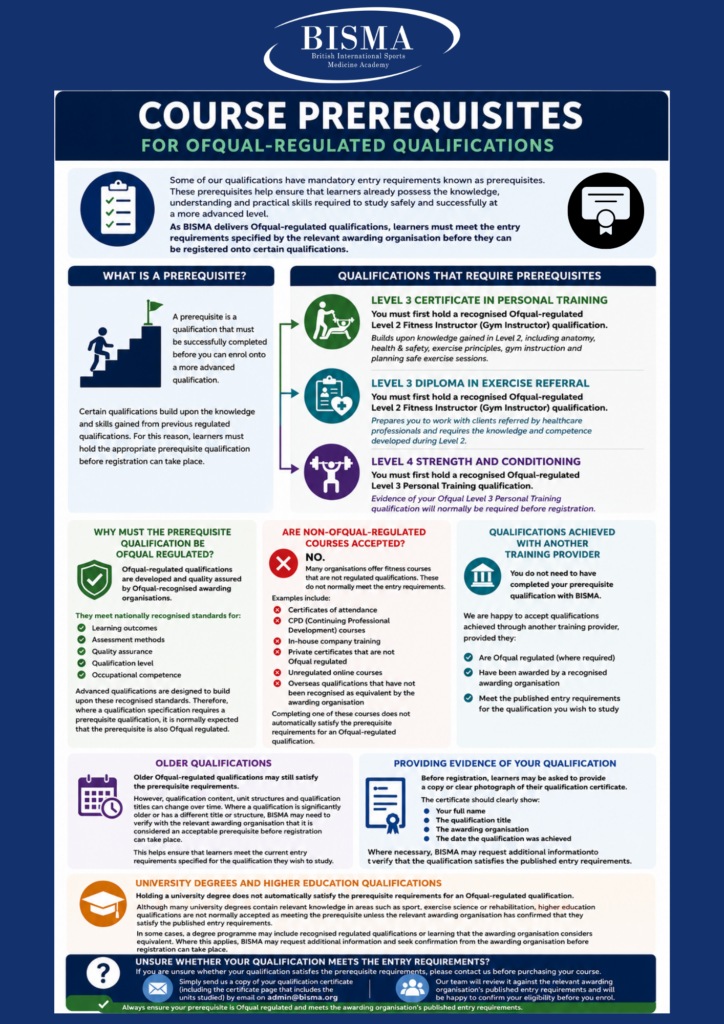
Overview
Some of our qualifications have mandatory entry requirements known as prerequisites. These prerequisites help ensure that learners already possess the knowledge, understanding and practical skills required to study safely and successfully at a more advanced level.
As BISMA delivers Ofqual-regulated qualifications, learners must meet the entry requirements specified by the relevant awarding organisation before they can be registered onto certain qualifications.
What Is a Prerequisite?
A prerequisite is a qualification that must be successfully completed before you can enrol onto a more advanced qualification.
Certain qualifications build upon the knowledge and skills gained from previous regulated qualifications. For this reason, learners must hold the appropriate prerequisite qualification before registration can take place.
Qualifications That Require Prerequisites
Level 3 Certificate in Personal Training
To enrol onto the Level 3 Certificate in Personal Training, you must first hold a recognised Ofqual-regulated Level 2 Fitness Instructor (Gym Instructor) qualification.
The Level 3 qualification builds upon the knowledge and practical skills gained during Level 2, including:
- Anatomy and physiology
- Health and safety within a fitness environment
- Principles of exercise and fitness
- Gym-based exercise instruction
- Planning and delivering safe exercise sessions
If you do not yet hold a Level 2 Fitness Instructor qualification, you may enrol onto our Combined Level 2 Fitness Instructor and Level 3 Personal Training Course, allowing you to complete both qualifications as part of one programme.
Level 3 Diploma in Exercise Referral
To enrol onto the Level 3 Diploma in Exercise Referral, you must first hold a recognised Ofqual-regulated Level 2 Fitness Instructor (Gym Instructor) qualification.
This qualification prepares fitness professionals to work with clients referred by healthcare professionals and therefore requires learners to already possess the knowledge and competence developed during a regulated Level 2 Fitness Instructor qualification.
Level 4 Strength and Conditioning
To enrol onto the Level 4 Strength and Conditioning qualification, you must first hold a recognised Ofqual-regulated Level 3 Personal Training qualification.
Evidence of your Ofqual Level 3 Personal Training qualification will normally be required before registration.
Why Must the Prerequisite Qualification Be Ofqual Regulated?
An Ofqual-regulated qualification has been developed and quality assured by an Ofqual-recognised awarding organisation and forms part of the regulated qualifications framework.
These qualifications are designed to meet nationally recognised standards for:
- Learning outcomes
- Assessment methods
- Quality assurance
- Qualification level
- Occupational competence
Advanced qualifications are designed to build upon these recognised standards. Therefore, where a qualification specification requires a prerequisite qualification, it is normally expected that the prerequisite is also an Ofqual-regulated qualification.
Are Non-Ofqual-Regulated Courses Accepted?
No. Many organisations offer fitness courses that are not regulated qualifications. Although these courses may provide useful knowledge, they do not normally satisfy the entry requirements for an Ofqual-regulated qualification where a regulated prerequisite is specified.
Examples include:
- Certificates of attendance
- CPD (Continuing Professional Development) courses
- In-house company training
- Private certificates that are not Ofqual regulated
- Unregulated online courses
- Overseas qualifications that have not been recognised as equivalent by the awarding organisation
Completing one of these courses does not automatically satisfy the prerequisite requirements for an Ofqual-regulated qualification.
Qualifications Achieved with Another Training Provider
You do not need to have completed your prerequisite qualification with BISMA.
We are happy to accept qualifications achieved through another training provider, provided they:
- Are Ofqual regulated (where required)
- Have been awarded by a recognised awarding organisation
- Meet the published entry requirements for the qualification you wish to study
Older Qualifications
Older Ofqual-regulated qualifications may still satisfy the prerequisite requirements.
However, qualification content, unit structures and qualification titles can change over time. Where a qualification is significantly older or has a different title or structure, BISMA may need to verify with the relevant awarding organisation that it is considered an acceptable prerequisite before registration can take place.
This helps ensure that learners meet the current entry requirements specified for the qualification they wish to study.
University Degrees and Higher Education Qualifications
Holding a university degree does not automatically satisfy the prerequisite requirements for an Ofqual-regulated qualification.
Although many university degrees contain relevant knowledge in areas such as sport, exercise science, physical education or rehabilitation, higher education qualifications are not normally accepted as meeting the prerequisite unless the relevant awarding organisation has confirmed that they satisfy the published entry requirements.
In some cases, a degree programme may include recognised regulated qualifications or learning that the awarding organisation considers equivalent. Where this applies, BISMA may request additional information, such as a transcript or module breakdown, and seek confirmation from the awarding organisation before registration can take place.
If you hold a university degree and are unsure whether it meets the entry requirements, please contact us before enrolling. Our team will review your qualifications and advise whether they are acceptable for the course you wish to study.
Providing Evidence of Your Qualification
Before registration, learners may be asked to provide a copy or clear photograph of their qualification certificate.
The certificate should clearly show:
- Your full name
- The qualification title
- The awarding organisation
- The date the qualification was achieved
Where necessary, BISMA may request additional information to verify that the qualification satisfies the published entry requirements.
Unsure Whether Your Qualification Meets the Entry Requirements?
If you are unsure whether your qualification satisfies the prerequisite requirements, please contact us before purchasing your course.
Simply send us a copy of your qualification certificate (including the certificate page that includes the units studied) by email on admin@bisma.org and our team will review it against the relevant awarding organisation’s published entry requirements. We will be happy to confirm your eligibility before you enrol.
Career Options for Qualified Personal Trainers
Becoming a qualified Personal Trainer can open the door to a flexible and rewarding career in the fitness industry.
Personal Trainers work with individuals who want to improve their health, fitness, confidence and physical performance. Depending on your goals, you may choose to work full-time, build a part-time business alongside another job, or operate independently as a self-employed fitness professional.
There is no single career path that suits everyone. Your working hours, income, responsibilities and opportunities will depend on the type of role you choose and how you develop your experience.

What Does a Personal Trainer Do?
A Personal Trainer designs and delivers exercise programmes based on each client’s needs, goals, experience and current fitness level.
Typical responsibilities may include:
- Conducting client consultations and fitness assessments
- Identifying appropriate health and fitness goals
- Planning individual exercise programmes
- Teaching safe and effective exercise techniques
- Monitoring client progress
- Adapting programmes when required
- Motivating and supporting clients
- Providing general guidance on healthy lifestyle habits
- Maintaining professional records
- Promoting Personal Training services
Personal Trainers may work with beginners, experienced gym users, older adults, athletes, people returning to exercise or clients with specific health and fitness goals.
Different Paths to Consider
Full-Time Employment
A full-time Personal Trainer may work for a gym, health club, leisure centre, hotel, fitness studio or other health and fitness organisation.
Some employers provide a fixed salary, while others offer a combination of basic pay, commission, bonuses and income from Personal Training sessions.
A full-time position may include duties such as:
- Delivering Personal Training sessions
- Completing gym inductions
- Supporting members on the gym floor
- Conducting fitness assessments
- Delivering group exercise sessions
- Following up with prospective clients
- Supporting membership retention
- Maintaining a clean and safe training environment
Advantages of Full-Time Employment
- Greater income stability
- Regular working hours
- Access to an established client base
- Experience working within a professional fitness environment
- Support from managers and other fitness professionals
- Potential employee benefits
- Opportunities to progress into supervisory or management roles
Points to Consider
Full-time roles may involve early mornings, evenings and weekends. Some positions may also include sales targets, membership duties or general gym-floor responsibilities alongside Personal Training.
Part-Time Personal Training
Part-time Personal Training can be suitable for people who want to enter the fitness industry gradually or continue working in another profession.
You may choose to train clients during mornings, evenings or weekends while maintaining another source of income.
Part-time work may be suitable for:
- People changing careers
- Parents and carers
- Students
- Fitness professionals developing a new specialism
- Individuals building a client base before becoming fully self-employed
- People looking to earn additional income
Advantages of Part-Time Work
- Greater flexibility
- Opportunity to retain another source of income
- Lower financial risk while establishing a client base
- Ability to gain experience gradually
- Freedom to choose a manageable number of clients
Points to Consider
Building a successful part-time client base can take time. You will need to manage your availability carefully and ensure that you can provide clients with consistent appointment times and professional support.
Self-Employed Personal Training
Self-employed Personal Trainers operate their own businesses and are responsible for finding clients, setting prices and managing their services.
You may work from:
- A commercial gym
- A private fitness studio
- A client’s home
- Outdoor training locations
- Rented gym or studio space
- Your own suitable training facility
- Online platforms
Some gyms allow Personal Trainers to operate in exchange for monthly rent, a licence fee or agreed working hours. Arrangements differ between facilities, so it is important to understand the terms before committing.
Advantages of Self-Employment
- Greater control over your working hours
- Freedom to set your own prices
- Ability to choose your preferred clients
- Opportunity to develop your own brand
- Potential to offer specialist services
- Greater control over how your business grows
- Potential to combine in-person and online coaching
Responsibilities of a Self-Employed Personal Trainer
Running your own Personal Training business involves more than delivering exercise sessions. You may also need to manage:
- Marketing and social media
- Client enquiries and consultations
- Bookings and cancellations
- Invoicing and payment collection
- Business expenses and financial records
- Insurance
- Tax and self-employment responsibilities
- Client records and data protection
- Professional development
- Equipment and facility arrangements
Self-employment can offer significant flexibility, but income may vary depending on the number of clients you have, the prices you charge and your ability to retain clients.
Other Career Opportunities
A Personal Training qualification may also support progression into related roles and services.
These may include:
- Gym Instructor
- Fitness Instructor
- Online Fitness Coach
- Group Exercise Instructor
- Bootcamp Instructor
- Corporate Fitness Trainer
- Hotel or Resort Fitness Trainer
- Mobile Personal Trainer
- Fitness Studio Owner
- Strength and Conditioning Coach
- Exercise Referral Practitioner
- Nutrition Specialist
- Fitness Tutor or Assessor
Some of these roles require additional qualifications, specialist training or professional experience.
Working in a Gym
Many newly qualified Personal Trainers begin their careers in a commercial gym.
Working within a gym can provide access to potential clients, equipment and an established fitness community. It can also allow you to gain experience by communicating with members and observing experienced fitness professionals.
Gym arrangements may include:
- Employment with a salary
- A self-employed rental agreement
- A licence to provide Personal Training
- A service-hours arrangement
- A commission-based model
- A combination of gym-floor hours and paid Personal Training
Before accepting a position, make sure you understand how the arrangement works, including fees, targets, working hours and any restrictions.
Online Personal Training
Online coaching allows Personal Trainers to support clients remotely.
Services may include:
- Personalised exercise programmes
- Video consultations
- Progress reviews
- Exercise demonstration videos
- Lifestyle and habit coaching
- Online group sessions
- Membership communities
- Messaging support
Online Personal Training can allow you to work with clients outside your local area. However, you will still need appropriate professional insurance, clear client screening procedures and effective systems for monitoring progress and delivering safe guidance.
Building a Successful Personal Training Career
Achieving your qualification is an important first step, but developing a successful career also requires professional skills, reliability and consistent effort.
Successful Personal Trainers often focus on:
- Providing excellent customer service
- Communicating clearly
- Understanding client needs
- Delivering safe and effective sessions
- Maintaining professional boundaries
- Creating a positive client experience
- Asking for reviews and referrals
- Continuing their professional development
- Developing a specialist area
- Building a professional online presence
Client retention is particularly important. Personal Trainers who listen to their clients, track progress and provide a dependable service are more likely to build long-term working relationships.
Choosing a Personal Training Specialism
Developing a specialist area can help you differentiate your services and attract a particular type of client.
Possible specialisms include:
- Weight management
- Strength training
- Muscle development
- Functional fitness
- Sports performance
- Older adult fitness
- Pre- and postnatal exercise
- Exercise referral
- Outdoor fitness
- Online coaching
- Nutrition support
- Injury prevention
- Kettlebell training
- Suspension training
- Circuit training
Additional qualifications may be required before working with certain populations or offering specialist services.
How Much Can a Personal Trainer Earn?
Personal Trainer earnings vary considerably.
Income may be affected by:
- Employment or self-employment status
- Location
- Experience
- Number of clients
- Session prices
- Gym fees
- Working hours
- Specialist qualifications
- Client retention
- Online services
- Group training services
- Business and marketing skills
A full-time employed role may provide greater stability, while self-employment may offer higher earning potential but less predictable income.
New Personal Trainers should plan realistically and allow time to build their reputation and client base.
Which Career Path Is Right for You?
The right path will depend on your personal circumstances and long-term goals.
A full-time role may suit you if you prefer regular hours, a structured environment and greater income stability.
Part-time Personal Training may be suitable if you want to gain experience while maintaining another job or responsibility.
Self-employment may appeal to you if you want greater flexibility, control over your prices and the opportunity to build your own fitness business.
Many Personal Trainers combine these options. For example, you could work part-time in a gym while developing your own clients or providing online coaching.
Start Your Personal Training Career with BISMA
BISMA offers the combined Level 2 Gym Instructor and Level 3 Personal Training course for learners who want to begin a career in the fitness industry.
Our flexible learning options allow you to develop the knowledge, practical skills and qualifications required to take your first steps as a fitness professional.
Depending on the course option selected, learners may benefit from:
- Online and face-to-face learning options
- Flexible study
- Tutor guidance
- Practical assessment opportunities
- Free assessments and unlimited reassessments
- Ofqual-regulated qualifications awarded by Focus Awards
- CIMSPA-recognised qualifications
- Additional continuing professional development courses
Begin Your Journey
Take the first step towards becoming a qualified Gym Instructor and Personal Trainer.
Explore our Level 2 and Level 3 Personal Training courses or contact BISMA for further information.
Telephone: 0800 612 4798
Email: admin@bisma.org
Website: www.bisma.org
How Do I Become a Personal Trainer in the UK?
If you are interested in fitness, health and helping people achieve their goals, becoming a personal trainer can be a rewarding career choice.
The most common route to becoming a personal trainer in the UK is to complete an Ofqual-regulated Level 2 Gym Instructor qualification (CIMSPA approved) followed by an Ofqual-regulated Level 3 Personal Trainer qualification (CIMSPA approved). Many learners choose a combined Level 2+3 Fitness Instructor and Personal Training qualification that includes both levels within a single programme.
Once qualified, personal trainers can work in gyms, health clubs, leisure centres, fitness studios or establish their own personal training businesses.
What Qualifications Do I Need to Become a Personal Trainer?
Most employers within the UK fitness industry look for a recognised Level 3 Personal Trainer qualification.
The qualification pathway normally consists of:
- Level 2 Gym Instructor Qualification
- Level 3 Personal Trainer Qualification
Many training providers offer these qualifications separately or as a combined programme.
Step 1: Complete a Level 2 Gym Instructor Qualification
The Level 2 Gym Instructor qualification provides the foundation knowledge required to work within a gym environment.
Learners typically study:
- Anatomy and physiology
- Principles of exercise
- Health and safety
- Resistance training
- Cardiovascular training
- Client support and motivation
- Gym-based exercise instruction
This qualification prepares learners to supervise gym users and instruct safe and effective exercise.
Step 2: Complete a Level 3 Personal Trainer Qualification
The Level 3 Personal Trainer qualification builds upon the knowledge gained at Level 2 and prepares learners to work directly with clients.
Topics commonly include:
- Client consultations
- Lifestyle and goal analysis
- Fitness assessments
- Exercise programming
- Programme reviews
- Nutritional guidance
- Behaviour change strategies
- Personal training delivery
Upon successful completion, learners can work as personal trainers within the fitness industry.
What Will I Learn During a Personal Trainer Course?
Personal trainer qualifications are designed to provide both theoretical knowledge and practical coaching skills.
Learners develop an understanding of:
- How the body responds to exercise
- How to assess client needs
- How to design safe exercise programmes
- How to adapt programmes for different individuals
- How to support clients in achieving their goals
- How to review and progress training plans
These skills form the foundation of professional personal training practice.
Are Practical Assessments Required?
Yes.
Personal trainer qualifications normally include practical assessments where learners demonstrate their ability to plan and deliver safe and effective exercise sessions.
Practical assessments help ensure learners can apply their knowledge in real-world situations and work professionally with clients.
Do I Need Previous Experience?
No.
Many learners begin their qualification with no previous fitness industry experience.
The qualification is designed to teach the knowledge and skills required to work as a personal trainer, making it suitable for beginners as well as those already involved in fitness.
Can I Study Full-Time or Part-Time?
Many qualifications offer flexible learning options.
Depending on the provider, learners may be able to study:
- Full-time
- Part-time
- Online
- Face-to-face
- Blended learning
This flexibility allows many people to study alongside work, family commitments or other responsibilities.
What Happens After I Qualify?
Once qualified, personal trainers can pursue a variety of career opportunities.
These may include:
- Working in commercial gyms
- Working in health clubs
- Delivering one-to-one personal training
- Providing small group training
- Running outdoor fitness sessions
- Delivering online coaching
- Becoming self-employed
Some trainers also continue their professional development through specialist qualifications.
Career Progression Opportunities
After qualifying as a personal trainer, many fitness professionals choose to expand their knowledge through additional qualifications.
Examples include:
- Strength and Conditioning
- Exercise Referral
- Nutrition
- Sports Massage
- Yoga
- Pre and Post Natal Exercise
These qualifications may allow trainers to work with a wider range of clients and develop specialist areas of expertise.
Common Misconceptions About Becoming a Personal Trainer
You Need to Be an Elite Athlete
This is not true.
Personal trainers come from a wide range of backgrounds. While an interest in fitness is beneficial, learners do not need to be competitive athletes to become successful personal trainers.
You Need a University Degree
A university degree is not usually required.
Most personal trainers enter the profession through vocational qualifications such as the Level 2 Gym Instructor and Level 3 Personal Trainer pathway.
You Need Years of Gym Experience
Many learners begin with little or no professional fitness experience. The qualification is designed to teach the skills required to work safely and effectively within the fitness industry.
Summary
To become a personal trainer in the UK, learners typically complete a Level 2 Gym Instructor qualification followed by a Level 3 Personal Trainer qualification, ensuring the courses are Ofqual regulated and CIMSPA approved. Many providers offer a combined programme that includes both qualifications.
These qualifications provide the knowledge and practical skills required to assess clients, design exercise programmes and deliver safe and effective personal training sessions.
Once qualified, personal trainers can work in gyms, health clubs, fitness studios or establish their own businesses, helping clients improve their health, fitness and wellbeing.
Feel free to visit our “Personal Training Hub” for more information about this topic.
How do I become a personal trainer in the UK?
The most common route to becoming a personal trainer in the UK is to complete an Ofqual regulated Level 3 Personal Trainer qualification. Learners first complete a Level 2 Gym Instructor qualification before progressing to Level 3 Personal Training. Once qualified, personal trainers can work in gyms, health clubs, fitness centres, or operate their own businesses.
Feel free to visit our “How Do I Become a Personal Trainer in the UK?” for more information about this topic.
How much does a personal training course cost in the UK?
The cost of a personal training course in the UK varies depending on the qualification level, learning method, support provided and course provider. Personal trainer courses typically range from around £700 to over £3,000. Factors that can influence the price include whether the course is completed online or face-to-face, the amount of tutor support available, assessment fees, course resources and any additional qualifications included within the programme.
When comparing personal training courses, it is important to consider the overall value provided rather than focusing solely on the lowest price. Qualification recognition, tutor support, assessment opportunities, flexibility and learner reviews are all important factors to consider when choosing a course.
Many learners choose a combined Level 2 Gym Instructor and Level 3 Personal Trainer qualification, as this provides a complete pathway into the fitness industry and may offer better value than purchasing the qualifications separately.
What is the cheapest way to become a personal trainer?
The cheapest way to become a personal trainer is often through a recognised distance learning or online qualification. Online courses can reduce travel and accommodation costs while allowing learners to study at their own pace around work and personal commitments.
Many learners find that enrolling on a combined Level 2 Gym Instructor and Level 3 Personal Trainer qualification is one of the most cost-effective routes into the fitness industry, as both qualifications are included within a single programme and provide the knowledge and skills required to begin working as a personal trainer.
What qualifications do I need to become a personal trainer?
Most employers and fitness facilities in the UK look for a Level 3 Personal Trainer qualification regulated by Ofqual that is also CIMSPA approved. This qualification provides the knowledge and practical skills required to design exercise programmes, conduct fitness assessments and support clients in achieving their fitness goals.
Do I need a Level 2 Gym Instructor qualification before studying Level 3 Personal Training?
Yes, unless you choose the Level 3 Personal Trainer qualification that includes the Level 2 Gym Instructor content as part of a combined programme. If you already hold a recognised Level 2 Gym Instructor qualification, you may be able to progress directly to Level 3 Personal Training.
How long does it take to become a personal trainer?
The time required varies depending on the course format and study commitment. Some learners complete their qualification within a few weeks, while others choose to study part-time over several months. Flexible learning programmes allow learners to progress at their own pace. Our students take around 6-8 weeks to complete their course.
Can I become a personal trainer online?
Yes. Many personal trainers qualify using online learning for the theory components. Practical assessments are assessed by video assessment or by attending an assessment day, required to demonstrate competence in delivering exercise instruction and personal training sessions.
Can I become a personal trainer without previous fitness experience?
Yes. Many people begin personal training qualifications with no previous industry experience. A good course will provide the knowledge and practical skills needed to work safely and effectively with clients.
Is a Level 3 Personal Trainer qualification worth it?
For individuals wishing to work as personal trainers, a Level 3 qualification is widely recognised within the fitness industry and can open opportunities for employment, self-employment and further professional development.
What is the difference between a gym instructor and a personal trainer?
A gym instructor typically supervises gym members, demonstrates equipment use and provides basic exercise guidance. A personal trainer works more closely with clients by conducting assessments, creating personalised exercise programmes and providing ongoing support and motivation.
What can I do with a Level 3 Personal Trainer qualification?
A Level 3 Personal Trainer qualification can lead to opportunities in gyms, health clubs, some fitness classes, nutrition coaching, fitness centres, corporate wellness programmes, online coaching and self-employed personal training businesses. Feel free to check our page “Career Options for Personal Trainers” for more information on this topic.
Can I work in a gym with a Level 3 Personal Trainer qualification?
Yes. A Level 3 Personal Trainer qualification is commonly accepted by employers within the fitness industry and may allow individuals to work with clients both within gyms and independently.
Can I become self-employed as a personal trainer?
Yes. Many personal trainers choose to operate as self-employed professionals, offering one-to-one coaching, small group training, online coaching or specialised fitness services.
How much do personal trainers earn in the UK?
Personal trainer earnings vary depending on location, experience, specialisms, client numbers and whether they are employed or self-employed. Income can range significantly depending on the services offered and business model used.
Can personal trainers earn over £50,000 per year?
Some experienced personal trainers who build a strong client base, develop specialist services or operate successful businesses may earn over £50,000 per year. Earnings depend on many factors including demand, pricing and working hours.
How much do self-employed personal trainers earn?
Self-employed personal trainers set their own prices and income can vary considerably. Factors such as location, reputation, marketing, client retention and specialisms can influence earning potential.
Is personal training a good career?
Many people find personal training rewarding because it allows them to help others improve their health, fitness and wellbeing while working in a dynamic and active environment.
Is there a demand for personal trainers in the UK?
Interest in health, fitness and wellbeing continues to create opportunities within the fitness industry. Demand may vary depending on location, target market and the services being offered.
What skills do I need to become a successful personal trainer?
Successful personal trainers often possess strong communication skills, professionalism, organisation, motivation, empathy, problem-solving abilities and a commitment to ongoing professional development.
Do I need insurance as a personal trainer?
Yes, many employers, facilities and professional organisations require personal trainers to hold appropriate insurance before working with clients. Insurance can help provide protection against potential claims arising from professional activities.
Do personal trainers need first aid qualifications?
Yes, many employers and facilities require personal trainers to hold a recognised first aid qualification. First aid knowledge can help trainers respond appropriately to emergencies that may occur during exercise sessions.
Can I work abroad with a UK personal training qualification?
Many countries recognise UK fitness qualifications as evidence of professional training. However, local employment, registration and licensing requirements vary and should always be checked before working overseas.
Is a UK personal training qualification recognised internationally?
UK fitness qualifications are widely respected in many countries. Recognition depends on the specific country, employer and local regulations.
Can I become a personal trainer part-time?
Yes. Many people study and work as personal trainers on a part-time basis while balancing other employment or personal commitments.
Can I become a personal trainer while working another job?
Yes. Personal training can often be started alongside existing employment, particularly during evenings, weekends or through online coaching services.
How old do I need to be to become a personal trainer?
Entry requirements vary between providers. Many qualifications are available to learners aged 16 and above, although employment requirements may vary between organisations.
Do I need GCSEs or A-levels to become a personal trainer?
Many personal training qualifications do not require GCSEs or A-levels. However, learners should check the entry requirements of the specific course provider.
What is included in a Level 3 Personal Trainer course?
Course content commonly includes anatomy and physiology, nutrition, client consultations, fitness assessments, programme design, exercise instruction, business awareness and practical coaching skills.
What practical assessments are required for a personal trainer qualification?
Practical assessments often require learners to demonstrate their ability to plan, deliver and evaluate safe and effective personal training sessions with clients.
How difficult is a Level 3 Personal Trainer qualification?
The qualification requires commitment and study, but many learners successfully complete it with appropriate support, practice and preparation.
How many assessments are included in a personal trainer course?
Assessment methods vary between providers and awarding organisations. These may include written assignments, portfolios, practical assessments, professional discussions and knowledge-based assessments.
What happens if I fail an assessment?
Assessment procedures vary between providers. Many providers offer opportunities for reassessment where learners have not yet demonstrated the required standard.
How long do I have to complete my personal trainer qualification?
Completion deadlines vary between providers and awarding organisations. Learners should review the specific completion requirements before enrolling.
Can I complete a personal trainer qualification at my own pace?
Many flexible learning programmes allow learners to study at a pace that suits their individual circumstances while remaining within the provider’s completion period.
What is the difference between CIMSPA recognition and Ofqual regulation?
Ofqual regulation relates to the qualification itself and helps ensure quality and consistency. CIMSPA recognition relates to professional standards within the sport and physical activity sector.
What does Ofqual regulated mean?
An Ofqual-regulated qualification has been approved within the regulated qualifications framework and must meet specific quality assurance requirements.
What does CIMSPA recognised mean?
CIMSPA recognition indicates that a qualification aligns with professional standards developed for the sport and physical activity sector.
Which personal trainer qualification is most recognised by employers?
Employers typically look for qualifications that are regulated, industry recognised and aligned with professional standards. Requirements may vary between organisations.
How do gyms verify personal trainer qualifications?
Employers commonly request qualification certificates and may verify qualifications through awarding organisations or recruitment processes.
Can I start my own personal training business?
Yes. Many qualified personal trainers establish their own businesses and offer services such as one-to-one coaching, group training, online coaching and specialised fitness programmes.
Can I train clients online as a personal trainer?
Yes. Many personal trainers provide online coaching services through video calls, training apps, digital programmes and remote support systems.
Can personal trainers offer nutrition advice?
Personal trainers can often provide general healthy eating guidance within the scope of their qualification. More advanced nutrition advice may require additional specialist qualifications.
Do personal trainers need a nutrition qualification?
While not always required, additional nutrition qualifications can help personal trainers expand their knowledge and services within their professional scope of practice.
Can I specialise after becoming a personal trainer?
Yes. Many personal trainers choose to specialise in areas such as weight management, strength and conditioning, exercise referral, older adults, sports performance, nutrition or pre- and postnatal fitness.
What qualifications can I study after Level 3 Personal Training?
Progression opportunities may include qualifications in strength and conditioning, sports massage, nutrition, exercise referral, coaching, yoga, Pilates and advanced fitness specialisms.
What is the difference between Level 2 and Level 3 Personal Training qualifications?
Level 2 Gym Instructor qualifications focus on supervising gym environments and instructing exercise. Level 3 Personal Training qualifications build on this knowledge and include client assessments, programme design and personalised coaching.
Can I become a personal trainer without going to university?
Yes. Many personal trainers enter the fitness industry through vocational qualifications rather than university degrees.
Is university required to become a personal trainer?
No. A university degree is not usually required to work as a personal trainer in the UK. Vocational fitness qualifications are the most common route into the profession.
How much does a personal trainer course cost?
Course prices vary depending on the provider, qualification package, learning method and level of support included. Prospective learners should compare course features as well as price.
Can I pay for a personal trainer course in instalments?
Many training providers offer payment plans that allow learners to spread the cost of their qualification over several months.
What should I look for when choosing a personal trainer course?
Important considerations may include qualification recognition, learning format, tutor support, assessment methods, flexibility, reputation, reviews and overall value for money.
Which personal trainer qualification is best for beginners?
Many beginners start with a combined Level 2 Gym Instructor and Level 3 Personal Trainer qualification, which provides a complete pathway into the fitness industry.
How quickly can I start working after qualifying as a personal trainer?
Once qualified and meeting any employer or insurance requirements, many personal trainers can begin working immediately, either through employment opportunities or self-employment.
BISMA Teaching & Assessment Team Induction and Continuing Professional Development (CPD) Policy
1. Purpose
The purpose of this policy is to ensure that all members of the teaching and assessment team receive appropriate induction and ongoing professional development to perform their roles effectively and maintain professional competence. BISMA is committed to supporting professional development and promoting continuous improvement across all areas of teaching, assessment, and quality assurance.
2. Scope
This policy applies to all members of the BISMA teaching and assessment team, including:
- Tutors
- Assessors
- Internal Quality Assurers (IQAs)
- Associate Tutors
- Associate Assessors
- Associate IQAs
All individuals involved in the delivery, assessment, or quality assurance of qualifications on behalf of BISMA are expected to comply with this policy.
3. Induction
All new members of the teaching and assessment team must complete an induction before carrying out their duties independently. The induction process helps individuals understand their role, responsibilities, and the standards expected by BISMA.
The induction may include:
- Introduction to BISMA
Individuals will be provided with information about BISMA, its qualifications, systems, procedures, and organisational structure. - Roles and Responsibilities
Individuals will receive guidance on their specific role and the duties they are expected to carry out. - Health and Safety
Individuals will be informed of relevant health and safety procedures and emergency arrangements. - Safeguarding
Individuals will be introduced to BISMA’s safeguarding responsibilities and reporting procedures. - Equality and Diversity
Individuals will be informed of BISMA’s commitment to fair treatment, inclusion, and equal opportunities. - Data Protection (GDPR)
Individuals will receive guidance on handling personal information securely and in accordance with data protection legislation. - Relevant Policies and Procedures
Individuals will be made aware of policies relevant to their role and responsibilities. - Awarding Organisation Requirements
Where applicable, individuals will be informed of the requirements set by awarding organisations and regulatory bodies. - Role-Specific Training
Additional training may be provided to ensure individuals are competent to perform their role.
Induction records may be maintained by BISMA as evidence that the induction process has been completed.
4. Continuing Professional Development (CPD)
BISMA encourages all members of the teaching and assessment team to undertake regular CPD to maintain and improve their knowledge, skills, and occupational competence.
Examples of CPD activities include:
- Training Courses
Formal training courses can help individuals develop new skills and maintain professional competence. - Webinars and Workshops
Attendance at webinars and workshops can support ongoing professional development and awareness of industry developments. - Industry Research and Reading
Individuals may undertake independent study by reading industry publications, guidance documents, and professional resources. - Professional Qualifications
Individuals may complete additional qualifications relevant to their role or area of expertise. - Standardisation Meetings
Participation in standardisation activities helps maintain consistency in assessment and quality assurance decisions. - Occupational Practice
Continuing to work within the industry can help individuals maintain current occupational knowledge and experience. - Internal Training Sessions
BISMA may provide internal training to support professional development and organisational requirements. - Awarding Organisation Training
Individuals may attend training provided by awarding organisations to remain up to date with qualification requirements.
5. Responsibilities of the Teaching & Assessment Team
Members of the teaching and assessment team are responsible for:
- Completing their Induction
Individuals should actively participate in the induction process and familiarise themselves with BISMA’s requirements. - Maintaining Professional Competence
Individuals should ensure that their knowledge and skills remain current and appropriate for their role. - Participating in Relevant CPD Activities
Individuals are encouraged to engage in professional development opportunities that support their role and responsibilities. - Complying with BISMA Policies and Procedures
Individuals must follow all relevant policies, procedures, and regulatory requirements.
6. BISMA Responsibilities
BISMA will:
- Provide Appropriate Induction for New Team Members
BISMA will ensure that new members of the teaching and assessment team receive sufficient information and guidance to carry out their role effectively. - Support Professional Development Where Appropriate
BISMA may provide training opportunities, guidance, and support to assist professional development. - Promote Continuous Improvement
BISMA aims to encourage a culture of learning and professional growth. - Maintain Induction and Training Records
BISMA may keep records of induction and training activities for quality assurance and compliance purposes.
7. Monitoring
Professional competence and development may be monitored through:
- Standardisation Activities
Participation in standardisation meetings and quality assurance activities may be reviewed. - Quality Assurance Processes
Internal quality assurance activities may identify training or development needs. - Performance Reviews
Discussions with managers may be used to identify strengths, achievements, and areas for development. - Team Meetings
Meetings may be used to communicate updates and support continuous improvement.
8. Review
This policy will be reviewed annually or sooner if required by changes to legislation, awarding organisation requirements, regulatory guidance, or BISMA procedures.
Related Policies
- Malpractice and Maladministration Policy
- Conflicts of Interest Policy
- Safeguarding Policy
- Equality and Diversity Policy
- Plagiarism Policy
- Complaints Policy
- Whistleblowing Policy
- Sanctions Policy
- Learner Appeals Policy
- Staff Induction and CPD Policy
- Learner Registration and Certification Policy
- Learner Induction Policy
- Internal Quality Assurance Policy
- Data Protection Policy
- Code of Conduct
- Health and Safety Policy
BISMA Internal Quality Assurance (IQA) Policy
1. Purpose
The purpose of this policy is to ensure that BISMA maintains consistent, fair, valid, reliable, and compliant assessment and quality assurance practices across all qualifications delivered by the centre.
This policy outlines the processes used to monitor and support assessors, maintain assessment standards, identify areas for improvement, and ensure compliance with the requirements of awarding organisations, regulators, and relevant legislation.
2. Scope
This policy applies to:
- All BISMA qualifications and programmes.
- All assessors, tutors, Internal Quality Assurers (IQAs), and centre staff involved in the assessment process.
- All assessment methods, including:
- Portfolio assessment
- Written assignments
- Practical observations
- Professional discussions
- Video assessments
- Recognition of Prior Learning (RPL), where applicable
3. Policy Statement
BISMA is committed to:
- Maintaining high standards of assessment.
- Ensuring assessment decisions are fair, valid, reliable, authentic, and sufficient.
- Supporting assessors through standardisation and continuous professional development.
- Identifying and addressing assessment risks.
- Maintaining compliance with awarding organisation requirements.
- Ensuring learners are assessed consistently regardless of assessor, location, or assessment method.
- Promoting continuous improvement throughout the centre.
4. Definitions
Assessor
An individual responsible for assessing learner work and making assessment decisions.
Internal Quality Assurer (IQA)
An individual responsible for monitoring assessment practices and ensuring consistency and quality of assessment decisions.
Standardisation
The process of ensuring all assessors apply assessment criteria consistently.
Sampling
The review of assessment decisions made by assessors to ensure accuracy and consistency.
5. Roles and Responsibilities
Centre Management
Centre Management shall:
- Ensure adequate resources are available for quality assurance activities.
- Support the implementation of this policy.
- Monitor compliance with awarding organisation requirements.
Internal Quality Assurer (IQA)
The IQA shall:
- Plan and implement IQA activities.
- Conduct sampling of assessment decisions.
- Observe assessors where appropriate.
- Provide feedback and support to assessors.
- Maintain accurate IQA records.
- Identify and manage assessment risks.
- Lead standardisation activities.
- Recommend corrective actions where required.
Assessors
Assessors shall:
- Assess learner work in accordance with qualification requirements.
- Maintain accurate assessment records.
- Participate in standardisation activities.
- Implement actions identified by the IQA.
- Maintain occupational competence and CPD.
6. Internal Quality Assurance Strategy
BISMA adopts a risk-based approach to internal quality assurance.
Factors considered when determining sampling requirements include:
- Newly appointed assessors.
- Newly approved qualifications.
- High learner numbers.
- High referral rates.
- Significant changes to qualification requirements.
- Previous assessment concerns.
- New assessment methods.
- Remote or video assessments.
Higher-risk areas shall receive increased sampling.
7. Sampling Strategy
The IQA shall sample assessment decisions throughout the learner journey.
Sampling may include:
- Assessment plans.
- Assessment decisions.
- Learner portfolios.
- Feedback provided to learners.
- Practical assessments.
- Video assessments.
- Recognition of Prior Learning evidence.
Sampling shall be:
- Planned.
- Recorded.
- Representative.
- Sufficient to ensure confidence in assessment decisions.
Sampling shall include:
- Different assessors.
- Different qualification units.
- Different learners.
- Pass and referral decisions.
- Different assessment methods.
8. Standardisation Meetings
BISMA shall conduct regular standardisation activities to ensure consistency.
Standardisation activities may include:
- Reviewing assessment decisions.
- Reviewing learner evidence.
- Discussing qualification updates.
- Reviewing awarding organisation guidance.
- Sharing good practice.
- Identifying training needs.
Records of standardisation activities shall be maintained.
9. Assessor Support and Development
BISMA is committed to supporting assessor development.
Support activities may include:
- Assessor inductions.
- Mentoring.
- Standardisation meetings.
- CPD activities.
- Awarding organisation updates.
- Observation and feedback.
Assessors are expected to maintain appropriate occupational competence and professional development relevant to their subject area.
10. Observation of Assessors
Where appropriate, assessors may be observed carrying out assessment activities.
Observations may be conducted:
- Face-to-face.
- Remotely.
- Through review of recorded assessment sessions.
The purpose is to:
- Ensure consistency.
- Promote best practice.
- Identify development opportunities.
11. Managing Assessment Risks
Potential risks include:
- Inconsistent assessment decisions.
- Insufficient evidence.
- Unqualified assessors.
- Delays in assessment.
- Conflicts of interest.
- Malpractice or maladministration.
- Changes in qualification requirements.
The IQA shall monitor risks and implement corrective actions where necessary.
12. Conflicts of Interest
All staff involved in assessment and quality assurance must declare any actual, potential, or perceived conflicts of interest.
Where a conflict exists, BISMA shall implement appropriate controls to protect the integrity of assessment decisions.
Examples include:
- Assessing family members.
- Assessing close friends.
- IQA sampling their own assessment decisions.
- Financial or personal interests affecting judgement.
13. Learner Feedback
Learner feedback may be used to support quality improvement.
Feedback may be collected through:
- Surveys.
- Reviews.
- Complaints.
- Appeals.
- Informal feedback.
Findings may be used to improve assessment and quality assurance processes.
14. Continuous Improvement
BISMA is committed to continuous improvement.
Quality assurance activities shall be reviewed regularly to identify:
- Good practice.
- Areas requiring improvement.
- Training requirements.
- Operational efficiencies.
Action plans shall be implemented where appropriate.
15. Record Keeping
The following records shall be maintained securely:
- IQA sampling plans.
- IQA reports.
- Standardisation records.
- Assessor observation records.
- CPD records.
- Conflict of interest declarations.
- Corrective action records.
- Quality improvement records.
Records shall be retained in accordance with awarding organisation and regulatory requirements.
16. Equality, Diversity and Inclusion
BISMA is committed to ensuring that all assessment and quality assurance activities are conducted fairly and without discrimination.
All learners shall be treated equally regardless of:
- Age
- Disability
- Gender
- Gender reassignment
- Marriage or civil partnership
- Pregnancy or maternity
- Race
- Religion or belief
- Sex
- Sexual orientation
Reasonable adjustments shall be implemented where appropriate and permitted by qualification requirements.
17. Review of Policy
This policy shall be reviewed:
- Annually;
- Following awarding organisation updates;
- Following regulatory changes; or
- Following identification of significant quality assurance issues.
18. Related Policies
- Malpractice and Maladministration Policy
- Conflicts of Interest Policy
- Safeguarding Policy
- Equality and Diversity Policy
- Plagiarism Policy
- Complaints Policy
- Whistleblowing Policy
- Sanctions Policy
- Learner Appeals Policy
- Staff Induction and CPD Policy
- Learner Registration and Certification Policy
- Learner Induction Policy
- Internal Quality Assurance Policy
- Data Protection Policy
- Code of Conduct
- Health and Safety Policy