

Evidence-Based Nutrition for Long-Term Health
Nutrition plays a major role in supporting long-term health, healthy ageing, disease prevention, physical performance, cognitive function and overall quality of life. Research from organisations such as the World Health Organization (WHO), Harvard T.H. Chan School of Public Health, American Heart Association (AHA), British Heart Foundation (BHF), Cancer Research UK, Diabetes UK and Mayo Clinic consistently suggests that long-term dietary habits may significantly influence lifespan, cardiovascular health, metabolic health and overall wellbeing.
Rather than focusing on short-term fad diets, extreme restrictions or “miracle foods,” most longevity-focused nutrition research supports sustainable dietary patterns based around minimally processed whole foods, balanced nutrition and long-term consistency.
Key Nutrition Principles for Health & Longevity
1. Prioritise Whole & Minimally Processed Foods
One of the most consistent findings across longevity research is the benefit of diets based primarily on minimally processed foods.
These commonly include:
- Vegetables
- Fruits
- Beans & legumes
- Whole grains
- Nuts & seeds
- Healthy fats
- Lean protein sources
Research from Mediterranean diet studies and Blue Zones populations consistently shows associations between whole-food dietary patterns and improved long-term health outcomes.
Research & References
- Harvard Healthy Eating Plate
- WHO Healthy Diet Guidance
- Blue Zones Nutrition Research
- Mayo Clinic Healthy Nutrition Guidance
2. Mediterranean-Style Dietary Patterns
The Mediterranean diet is one of the most researched dietary patterns associated with health and longevity.
Common features include:
- Vegetables
- Olive oil
- Legumes
- Fish
- Nuts
- Whole grains
- Limited ultra-processed foods
Research has associated Mediterranean-style dietary patterns with:
- Improved cardiovascular health
- Reduced mortality risk
- Better metabolic health
- Improved cognitive health
Research & References
- Harvard Guide to the Mediterranean Diet
- American Heart Association – Mediterranean Eating Pattern
- British Heart Foundation – Mediterranean Diet
3. Plant-Focused Nutrition
Many longevity-focused dietary patterns are largely plant-focused.
These commonly emphasise:
- Vegetables
- Beans & legumes
- Fruits
- Whole grains
- Nuts & seeds
Plant-focused dietary patterns are commonly associated with:
- Improved heart health
- Improved gut health
- Higher fibre intake
- Reduced inflammation
- Better metabolic health
Research & References
- Harvard Nutrition Source – Plant-Based Diets
- American Institute for Cancer Research
- Blue Zones Diet Research
4. Adequate Protein Intake
Protein plays an important role in:
- Muscle maintenance
- Healthy ageing
- Recovery
- Bone health
- Immune function
This becomes increasingly important with ageing due to the natural decline in muscle mass over time.
Examples of protein sources include:
- Fish
- Eggs
- Greek yogurt
- Beans
- Lentils
- Tofu
- Lean meats
Research & References
- National Institute on Aging – Protein & Aging
- Harvard Nutrition Source – Protein
- British Nutrition Foundation
5. Fibre & Gut Health
Higher fibre intake is strongly associated with improved long-term health.
Fibre may support:
- Gut microbiome health
- Digestive health
- Cholesterol management
- Blood sugar regulation
- Satiety
High-fibre foods commonly include:
- Beans
- Lentils
- Vegetables
- Fruits
- Whole grains
- Oats
- Seeds
Research & References
6. Healthy Fats
Research commonly supports prioritising healthier fat sources over excessive trans fats and heavily processed fats.
Examples of healthier fats include:
- Olive oil
- Nuts
- Seeds
- Avocados
- Oily fish
These may support:
- Heart health
- Brain function
- Hormone production
- Nutrient absorption
Research & References
- American Heart Association – Healthy Fats
- Harvard Nutrition Source – Fats & Cholesterol
- British Heart Foundation – Healthy Fats
7. Hydration
Adequate hydration supports:
- Cognitive function
- Physical performance
- Recovery
- Temperature regulation
- General health
Water is generally considered the primary hydration source for overall health.
Research & References
8. Limiting Ultra-Processed Foods
Many health organisations recommend reducing:
- Ultra-processed foods
- Sugary drinks
- Excess refined sugar
- Highly processed snacks
Ultra-processed diets are commonly associated with:
- Higher obesity risk
- Poorer metabolic health
- Increased cardiovascular risk
- Poorer dietary quality
Research & References
- WHO Healthy Diet Recommendations
- Harvard Ultra-Processed Foods Research
- Cancer Research UK – Diet & Cancer Risk
A Simple Longevity-Focused Plate
A balanced longevity-focused meal commonly includes:
- Plenty of vegetables and fruits
- Moderate protein sources
- Whole-food carbohydrate sources
- Healthy fats in moderation
- High-fibre foods
- Mostly minimally processed foods
Rather than focusing on strict dieting rules, many evidence-based nutrition approaches focus on overall dietary quality and long-term consistency.
Common Themes Seen in Longevity-Focused Diets
Many dietary patterns associated with longevity commonly include:
- Vegetables
- Beans & legumes
- Fruits
- Whole grains
- Nuts & seeds
- Olive oil
- Moderate calorie intake
- Limited ultra-processed foods
- Limited added sugars
Research from Blue Zones populations and Mediterranean dietary studies commonly highlights these recurring patterns.
One of the Most Important Factors: Consistency
Research consistently suggests that:
Long-term sustainable habits matter more than short-term extreme diets.
The best nutrition approach for long-term health is usually one that is:
- Balanced
- Sustainable
- Enjoyable
- Mostly whole-food based
- Realistic long term
Additional Major Research Organisations & Universities
- Harvard T.H. Chan School of Public Health
- World Health Organization (WHO)
- American Heart Association (AHA)
- British Heart Foundation (BHF)
- Cancer Research UK
- Diabetes UK
- Mayo Clinic
- National Institute on Aging
- British Dietetic Association
- Academy of Nutrition and Dietetics
Important Reminder
Nutrition needs vary depending on:
- Age
- Medical conditions
- Allergies
- Activity levels
- Goals
- Medications
Individuals with medical conditions or dietary concerns should seek guidance from an appropriately qualified healthcare professional or registered dietitian before making significant dietary changes.
Further Reading
- Would you like to learner about Exercise for Health & Longevity next?

Overview
Exercise plays a major role in supporting long-term health, mobility, independence and overall quality of life. Research from organisations such as the American College of Sports Medicine (ACSM), World Health Organization (WHO), British Heart Foundation (BHF), Cancer Research UK, Diabetes UK and many leading universities consistently shows that regular physical activity is associated with improved cardiovascular health, stronger muscles and bones, better mental wellbeing, improved balance and mobility, and reduced risk of many chronic diseases. A balanced exercise programme should not focus on just one type of training, but instead combine cardiovascular exercise, strength training, mobility work, flexibility, balance, recovery and regular daily movement. This guide explores the major types of exercise that may support health and longevity, using the FITT Principle (Frequency, Intensity, Time and Type) to help provide practical, evidence-based recommendations for a balanced and sustainable approach to exercise.
Using the FITT Principle
One of the most evidence-based ways to structure exercise for long-term health and longevity is by using the FITT Principle.
FITT stands for:
- Frequency — How often you exercise
- Intensity — How hard you exercise
- Time — How long you exercise for
- Type — What type of exercise you perform
Using the FITT principle helps create a more balanced, safe and sustainable exercise programme.
Major organisations including the American College of Sports Medicine (ACSM), World Health Organization (WHO), British Heart Foundation (BHF), Cancer Research UK, Diabetes UK, NHS and American Heart Association (AHA) strongly recommend regular physical activity for long-term health and disease prevention.
1. Low-Intensity Cardiovascular Exercise
Low-intensity cardiovascular activity is strongly associated with improved long-term health, improved circulation, stress reduction and lower disease risk.
Walking is one of the most evidence-supported forms of exercise for longevity.
FITT Recommendations
Frequency
- 5–7 days per week
Intensity
- Low to moderate
- Comfortable pace
- Able to hold a conversation
Time
- 20–90 minutes per session
- Around 150–300 minutes per week total
Type
- Walking
- Easy cycling
- Hiking
- Light swimming
- Low-intensity cardio machines
Benefits
- Supports heart health
- Helps regulate blood sugar
- Supports recovery
- Helps reduce stress
- Low injury risk
- Sustainable long term
Research & References
- WHO Physical Activity Guidelines
- NHS Physical Activity Guidelines for Adults
- British Heart Foundation – Walking for Health
- Harvard T.H. Chan School of Public Health – Physical Activity
2. High-Intensity Exercise & VO2 Max Training
VO2 max is considered one of the strongest predictors of cardiovascular fitness and longevity.
Higher VO2 max levels are associated with improved cardiovascular health and reduced mortality risk.
FITT Recommendations
Frequency
- 1–3 sessions per week
Intensity
- High intensity
- Difficult breathing
- Challenging effort
Time
- 10–30 minutes total work
- Intervals commonly:
- 15 seconds–4 minutes
Type
- Sprint intervals
- Hill sprints
- HIIT circuits
- Fast rowing
- Running intervals
- Cycling intervals
Benefits
- Improves VO2 max
- Improves cardiovascular fitness
- Time efficient
- Improves endurance
- Improves insulin sensitivity
Important Note
Excessive high-intensity training without adequate recovery may increase:
- Fatigue
- Burnout
- Injury risk
- Overtraining risk
Research & References
- ACSM High-Intensity Interval Training Information
- American Heart Association – HIIT
- Mayo Clinic – Exercise Intensity
- Cleveland Clinic – VO2 Max Explained
3. Strength Training
Strength training is one of the most effective ways to maintain muscle mass, bone density and functional independence with ageing.
FITT Recommendations
Frequency
- 2–4 sessions per week
Intensity
Generally moderate intensity:
- Around 5–8/10 effort
- Challenging but controlled
- Good exercise technique
- Avoiding constant maximal lifting
Time
- Around 30–75 minutes per session
Type
- Resistance machines
- Dumbbells
- Barbells
- Bodyweight exercises
- Resistance bands
- Functional resistance exercises
Benefits
- Maintains muscle mass
- Supports bone density
- Improves posture
- Improves insulin sensitivity
- Helps maintain independence
- Improves joint stability
Research & References
- ACSM Resistance Training Guidelines
- NHS Strength Exercises
- Harvard Medical School – Strength Training and Longevity
- National Institute on Aging – Strength Training
4. Flexibility Training
Flexibility training helps maintain muscle and connective tissue range of motion.
FITT Recommendations
Frequency
- 2–7 days per week
Intensity
- Mild tension
- No pain
Time
- Hold stretches:
- Around 10–60 seconds
- Total:
- Around 5–20 minutes
Type
- Static stretching
- Yoga
- Gentle flexibility routines
Benefits
- Improves range of motion
- Reduces stiffness
- May improve posture
- Supports movement quality
Research & References
5. Mobility Training
Mobility training helps maintain controlled joint movement and functional movement quality.
FITT Recommendations
Frequency
- 3–7 days per week
Intensity
- Controlled movement
- Comfortable range
- No aggressive forcing
Time
- Around 5–20 minutes
Type
- Dynamic mobility drills
- Joint rotations
- Yoga flows
- Controlled movement exercises
Benefits
- Supports joint health
- Improves movement quality
- Helps reduce injury risk
- Supports healthy ageing
Research & References
6. Balance Training
Balance training helps reduce fall risk and supports coordination.
FITT Recommendations
Frequency
- 2–5 days per week
Intensity
- Controlled challenge
- Safe instability
Time
- Around 5–20 minutes
Type
- Single-leg exercises
- Tai Chi
- Stability drills
- Controlled bodyweight exercises
Benefits
- Improves stability
- Improves coordination
- Reduces fall risk
- Improves body awareness
Research & References
- CDC – Balance Exercises for Older Adults
- National Institute on Aging – Balance Exercises
- NHS Falls Prevention Advice
7. Functional Training
Functional training improves movement patterns used in daily life.
FITT Recommendations
Frequency
- 2–4 days per week
Intensity
- Moderate
- Controlled movement quality
Time
- Around 20–60 minutes
Type
- Squats
- Carries
- Lunges
- Push/pull patterns
- Rotational exercises
Benefits
- Supports healthy ageing
- Improves practical strength
- Improves daily function
- Improves coordination
Research & References
8. Core Stability Training
Core training helps support posture, spinal stability and movement efficiency.
FITT Recommendations
Frequency
- 2–5 days per week
Intensity
- Moderate muscular control
- Good posture maintained
Time
- Around 5–20 minutes
Type
- Planks
- Dead bugs
- Pallof press
- Bird dogs
Benefits
- Improves posture
- Supports spinal stability
- Improves balance
- Supports movement control
Research & References
9. Coordination & Cognitive Movement Training
Activities combining movement with cognitive challenge may help support neurological health.
FITT Recommendations
Frequency
- 1–4 sessions per week
Intensity
- Low to moderate
Time
- Around 20–60 minutes
Type
- Dance
- Martial arts
- Racquet sports
- Agility drills
Benefits
- Supports coordination
- Improves reaction time
- Supports cognitive function
- Encourages brain-body connection
Research & References
- Alzheimer’s Society – Exercise and Brain Health
- Harvard Medical School – Exercise and Brain Function
10. Recovery & Recovery-Based Movement
Recovery is essential for adaptation, injury prevention and sustainable long-term health.
FITT Recommendations
Frequency
- Daily recovery practices recommended
Intensity
- Very low intensity
Time
- 5–60 minutes depending on activity
Type
- Walking
- Stretching
- Yoga
- Breathing exercises
- Gentle cycling
Benefits
- Supports recovery
- Reduces stress
- Improves sleep
- Supports consistency
Research & References
Additional Major Health & Research Organisations
- Johns Hopkins Medicine
- Mayo Clinic – Fitness & Exercise
- Stanford Medicine Lifestyle Medicine
- Oxford University – Physical Activity Research
- University College London (UCL) – Exercise & Health Research
Important Reminder
Individuals with injuries, medical conditions or health concerns should consult an appropriate healthcare professional before starting a new exercise programme.
Further Reading
- Would you like to learner about Nutrition for Health & Longevity next?

Overview
At BISMA, we aim to provide high-quality fitness qualifications affordable and accessible to as many learners as possible.
Whether you are looking for a personal training qualification, fitness instructor qualification, or professional development course, we understand that course costs can be an important consideration when starting a new career in the fitness industry.
Do We Offer Government-Funded Courses?
BISMA does not currently offer public funding, government funding, funded courses, government-funded courses, charity-funded courses, or government-backed student loans.
We do not currently receive funding from government departments, local authorities, charities, or public funding bodies that would allow us to offer free funded courses, funded PT courses, funded fitness courses, or funded personal training courses.
As a result, all BISMA courses are self-funded by learners or funded through private arrangements such as employer sponsorship, personal finance, grants, or external funding sources obtained independently by the learner.
Our Affordable Course Options
Rather than relying on government funding, BISMA focuses on providing high-quality qualifications at competitive prices.
Our courses are designed to offer excellent value while still including:
- Comprehensive learning materials
- Tutor support
- Practical assessments
- FREE reassessments (where applicable)
- Online learning resources
- Ofqual-regulated qualifications (where applicable)
- CIMSPA-recognised qualifications (where applicable)
We also offer flexible monthly payment plans, allowing learners to spread the cost of their course over time rather than paying the full amount upfront.
Many learners choose this option as an alternative to student loans or other forms of education finance.
Can Learners Find Their Own Funding?
Yes.
Learners are welcome to seek external funding independently if they wish to obtain financial support for their training.
Potential funding options may include:
- Employer sponsorship
- Local authority funding schemes
- Career development grants
- Adult education funding programmes
- Charity grants
- Employment and retraining support schemes
- Professional development funding
Any funding arrangement would need to be organised directly between the learner and the funding provider.
Useful Funding Resources
The following organisations may provide information about education funding, skills funding, career development support, grants, employment assistance, or training opportunities.
UK Government Funding Information
- UK Government – Find a Grant
- UK Government – Education and Learning Information
- National Careers Service
Employment Support
Charities and Grant Search Organisations
- Turn2us – Grants Search Service
- Family Action Educational Grants
- Lightning Reach
- The Prince’s Trust (for eligible young people)
Local Authority Funding
Many local councils offer skills development, employment support, adult education funding, and career development programmes.
You can find your local council using:
Employer Sponsorship
Some employers may be willing to fund or partially fund fitness qualifications where the training benefits the business.
If you are currently employed, it may be worth discussing professional development opportunities with your employer before enrolling.
Why Many Learners Choose BISMA
Although BISMA does not currently offer government-funded fitness courses or funded personal training courses, many learners choose us because of our:
- Affordable course fees
- Flexible monthly payment plans
- Online and face-to-face study options
- FREE reassessments
- Ongoing tutor support
- Established reputation within the fitness industry
- Ofqual-regulated qualifications through recognised awarding organisations
Summary
BISMA does not currently provide public funding, government funding, funded courses, funded PT courses, funded fitness courses, funded personal training courses, or government-backed student loans.
However, we strive to make our qualifications accessible through competitive pricing, flexible payment plans, and high-quality learner support. Learners who require funding are welcome to explore external grants, employer sponsorship, local authority funding schemes, charities, and government support programmes that may be available to them.
Overview
As part of your course, you will be required to complete one or more practical assessments to demonstrate your competence and meet the qualification requirements.
BISMA offers several assessment options to provide flexibility while ensuring all learners are assessed fairly and consistently.
Standard Practical Assessment Day (Included in Course Price)
The standard practical assessment option is included within the course price at no additional cost.
Learners are invited to attend one of our scheduled assessment days, where an assessor will observe them completing the practical assessment requirements for their qualification.
Assessment Day Times
Assessment days normally:
- Start at 12:00 noon
- Finish at approximately 7:00 pm
Learners are expected to attend the assessment day for the full duration. This allows sufficient time for assessments to be completed, feedback to be provided, and any administrative requirements to be completed.
Please ensure you arrive on time and remain available throughout the assessment day unless otherwise instructed by BISMA.
Benefits of Attending an Assessment Day
- Direct support from assessors
- Opportunity to ask questions before the assessment
- Immediate clarification if required
- Face-to-face assessment experience
- No additional assessment fees
Video Assessment Option (Included in Course Price)
Learners who are unable to attend our scheduled assessment days in person (in full 7 hours) have the option to submit a video assessment instead.
The video assessment option is also included within the course price and does not incur any additional fees.
Video assessments allow learners to complete their practical assessment at a suitable location and time, provided they follow the assessment guidance and recording requirements provided by BISMA.
Important Video Assessment Requirements
- The assessment must be recorded according to the official assessment guidance.
- The video must clearly demonstrate all required assessment criteria.
- Both the learner and client must remain visible throughout the assessment where required.
- Audio must be clear and audible.
- Video editing, cuts, pauses, splicing or alterations are not permitted unless specifically authorised by BISMA.
Detailed guidance for video assessments is available within the learner portal.
Premium Practical Assessment (Dedicated Time Slot)
Learners who require a practical assessment on a specific date, time and/or location may choose to purchase a Premium Practical Assessment (Dedicated Time Slot).
This optional service allows BISMA to arrange a dedicated assessment appointment outside the standard assessment schedule, subject to assessor and venue availability.
Cost
£100 per practical assessment
Examples:
- Level 2 Gym Instructor Practical Assessment = £100
- Level 3 Personal Trainer Practical Assessment = £100
- Level 2 and Level 3 Practical Assessments booked separately as dedicated appointments = £200 total
Suitable For Learners Who:
- Cannot attend a scheduled assessment day
- Require a specific assessment date
- Require a specific assessment time
- Require a specific assessment location
- Prefer a dedicated assessment appointment
For full details, booking procedures, terms and conditions, please visit the:
Premium Practical Assessment (Dedicated Time Slot) page.
Which Assessment Option Should I Choose?
| Assessment Option | Included in Course Price? | Additional Cost |
|---|---|---|
| Standard Assessment Day | Yes | £0 |
| Video Assessment Submission | Yes | £0 |
| Premium Practical Assessment (Dedicated Time Slot) | No | £100 per assessment |
Most learners choose either the Standard Assessment Day or Video Assessment Submission, both of which are included within the course price.
The Premium Practical Assessment (Dedicated Time Slot) is an optional convenience service for learners who require a bespoke assessment arrangement outside the standard options provided.
If you are unsure which assessment option is most suitable for you, please contact BISMA for guidance before booking your assessment.
Premium Practical Assessment (Dedicated Time Slot)
Premium Practical Assessment (Dedicated Time Slot) Book Here
The Premium Practical Assessment (Dedicated Time Slot) service allows learners to request a practical assessment on a specific date, time and location that is convenient for them, subject to assessor and venue availability.
This service is designed for learners who are unable to attend a standard assessment day or who would prefer a dedicated assessment appointment outside the normal assessment schedule.
How to Book
- Contact BISMA by email on admin@bisma.org provide:
- Your full name
- Qualification/course name
- Preferred assessment date
- Preferred assessment time
- Preferred assessment location
- BISMA will check assessor and venue availability and confirm whether the requested appointment can be arranged.
- If the requested appointment is available, you will be asked to make a payment of £100 per practical assessment for the Premium Practical Assessment service. Learners requiring multiple dedicated assessments will be charged separately for each assessment. For example, learners booking both the Level 2 Gym Instructor Practical Assessment and the Level 3 Personal Trainer Practical Assessment as dedicated appointments will be required to pay £200 in total (£100 per assessment).
- Once payment has been received, your assessment booking will be confirmed and the appointment details will be sent to you.
Important Information
- The £100 Premium Practical Assessment fee is non-refundable once the booking has been confirmed.
- Availability is not guaranteed and is subject to assessor and venue availability.
- Learners should ensure they are fully prepared and have completed any required paperwork before booking their practical assessment.
- The assessment time-slot is set to last for around 1 hour, the specific details of the assessment need to be confirmed by email on admin@bisma.org prior to booking this service.
- Requests to change the assessment date, time or location after confirmation may not be possible and, if approved, may incur additional charges.
- This fee covers the arrangement of a dedicated assessment appointment and does not guarantee a pass result. Learners must still successfully meet all assessment criteria to pass the practical assessment.
- Learners who fail a practical assessment may be required to book and pay for a new Premium Practical Assessment appointment if they wish to arrange another dedicated assessment time slot.
Standard Assessment Option
Please note that standard practical assessment opportunities are already included within the course price at no additional cost. Learners may attend one of BISMA’s scheduled assessment days or, where permitted by the qualification, submit a video assessment. Video assessments are included within the course price and do not incur any additional fees.
The Premium Practical Assessment (Dedicated Time Slot) service is an optional convenience service for learners who require a bespoke assessment date, time and/or location outside the standard assessment arrangements.
By booking a Premium Practical Assessment (Dedicated Time Slot), you acknowledge and accept the terms outlined above.
Overview
Recognition of Prior Learning (RPL) is a process used within some Ofqual-regulated qualifications to recognise previous learning, qualifications, knowledge, skills, or experience that may be relevant to a qualification.
RPL may allow learners to avoid repeating learning or assessment where sufficient evidence already exists and where permitted by the awarding body.
What Is RPL?
RPL stands for Recognition of Prior Learning.
This process is commonly used to review whether a learner’s previous qualifications, work experience, training, or professional competence may count towards part of a qualification.
RPL can apply to:
- previous Ofqual-regulated qualifications,
- equivalent regulated units,
- work-based learning,
- professional training,
- or industry experience.
Important Information About RPL
RPL is not automatically guaranteed.
All RPL requests are subject to:
- awarding body rules,
- qualification regulations,
- evidence review,
- and approval requirements.
Training centres must follow the policies set by the awarding organisation and regulators.
Ofqual does not guarantee that RPL will be accepted for a qualification. Each awarding body sets its own RPL rules and approval requirements.
RPL – EXPLAINED

How RPL Is Normally Assessed
RPL is normally reviewed by comparing the learner’s previous learning against:
- unit learning outcomes,
- assessment criteria,
- qualification level,
- and vocational relevance.
Evidence normally needs to be:
- valid,
- sufficient,
- authentic,
- current,
- and relevant.
Exact Unit Matches
RPL is normally only considered where learners already hold exact matching or directly equivalent units.
In most cases, matching:
- unit names,
- unit reference numbers,
- learning outcomes,
- and assessment criteria
are normally required for RPL to be granted.
Exact matches for both the unit title and unit reference number usually provide the strongest basis for approval.
It is unlikely that RPL would normally be granted where a learner only holds a similar unit name without an exact match for the unit reference number and qualification content.
This is because awarding bodies must ensure that the previous learning fully matches the regulated unit requirements, standards, and assessment criteria.
Recency of Learning
Vocational competence and industry knowledge must normally be current.
For many vocational and fitness qualifications, previous learning is commonly expected to have been completed within approximately the last 5 years, although this can vary depending on the qualification and awarding body requirements.
Qualifications that are 5 years old or older do not normally qualify for RPL approval, especially where the qualification relates to:
- practical competence,
- health and safety,
- safeguarding,
- client support,
- vocational practice,
- or industry standards that may have changed over time.
Older qualifications may require:
- additional evidence,
- reassessment,
- updated coursework,
- or completion of newer units.
All RPL decisions remain subject to awarding body rules and approval requirements.
RPL Limitations
Some parts of qualifications may not be eligible for RPL.
This can include:
- practical assessments,
- observations,
- externally assessed exams,
- professional discussions,
- or competency-based assessments.
In many cases, learners may still need to complete practical assessments even where previous learning is recognised.
University Degrees and Overseas Qualifications
University degrees, overseas qualifications, and non-Ofqual qualifications do not automatically qualify for RPL.
These qualifications may require:
- detailed unit mapping,
- awarding body review,
- and formal approval before any exemption can be considered.
Holding a university degree, overseas qualification, or professional membership does not automatically mean that a learner meets the unit requirements for an Ofqual-regulated qualification.
Fitness Industry Qualifications
For fitness qualifications such as:
- Level 2 Gym Instructor,
- Level 3 Personal Training,
- Level 4 Strength and Conditioning,
- Exercise Referral,
- or similar vocational qualifications,
RPL is commonly restricted unless learners already hold equivalent Ofqual-regulated units or qualifications.
This is because practical competence, health and safety, client support, and vocational standards must still be demonstrated.
How Does an Ideal RPL Certificate Looks Like?
An ideal certificate for RPL consideration would normally be an Ofqual-regulated qualification issued recently, ideally within the last 5 years.
For example, when using a Level 3 Personal Training qualification to apply for possible RPL exemptions or unit recognition for another Ofqual-regulated qualification, the certificate would normally include the details explained within this page, including:
- the qualification title,
- qualification number,
- awarding body information,
- unit breakdown,
- and regulated qualification details.
Exact matching unit names and unit reference numbers would normally provide the strongest basis for possible RPL approval. This page explains further the requirements for a RPL compliant certification, using the level 3 personal training qualification as an example.
Important Notice
Submitting evidence for RPL review does not guarantee approval.
All RPL decisions are subject to:
- awarding body rules,
- qualification regulations,
- and final approval requirements.
Training centres cannot independently approve RPL outside the rules set by the awarding organisation.
Contact Us
If you would like us to review a qualification for possible RPL or exemption consideration, please contact us before enrolling and provide:
- copies of certificates,
- transcripts,
- unit breakdowns,
- and any relevant supporting evidence.
Overview
This page explains the entry requirements for the level 4 strength and conditioning course.
Level 4 Strength and Conditioning Entry Requirements
Before enrolling on the Ofqual-regulated Level 4 Strength and Conditioning qualification, learners must meet the required entry criteria.
To join this qualification, learners must hold an Ofqual-regulated Level 3 Personal Training qualification.
This is the standard entry requirement for this course.

What Qualification Do I Need?
Learners must hold a recognised Ofqual-regulated Level 3 Personal Training certificate before enrolling on the Level 4 Strength and Conditioning qualification. If you would like to know how a level 3 personal training certificate should look like and the specifics on how to identify an official certification please use this page to find out more: Click Here
This helps ensure that learners already have the required knowledge, practical skills, and professional understanding expected before progressing to Level 4 study.
Does CIMSPA Membership Count as a Qualification?
A CIMSPA Personal Trainer Practitioner membership alone does not normally meet the entry requirements for this qualification.
CIMSPA membership may show professional registration, but it does not replace the requirement to hold an Ofqual-regulated Level 3 Personal Training qualification.
Do Overseas Qualifications Count?
Overseas personal training qualifications that are not Ofqual-regulated do not normally meet the entry requirements on their own.
If a learner holds an overseas qualification, it may need to be reviewed separately by the awarding body before enrolment can be approved.
Do University Degrees Count?
University degrees such as a Bachelor’s, Master’s, PhD, Sports Science degree, or similar academic qualification do not normally replace the specific requirement for an Ofqual-regulated Level 3 Personal Training qualification.
This is because the Level 4 Strength and Conditioning qualification has a specific vocational entry requirement linked to personal training competence.
Other Non-Ofqual Qualifications
Other fitness, sport, or training qualifications that are not Ofqual-regulated do not normally meet the entry requirements on their own.
Important Information
If you believe you hold an equivalent Ofqual-regulated qualification, please contact us before enrolling.
All equivalent qualifications are subject to review and approval by the awarding body before enrolment.
Summary
To enrol on the Level 4 Strength and Conditioning qualification, learners must normally hold an Ofqual-regulated Level 3 Personal Training qualification.
When checking a Level 3 Personal Training certificate, it is important to make sure the certificate contains the correct qualification details and that it has been issued by a recognised awarding body.
This page explains the key elements normally found on an official Level 3 Personal Training certificate.
The infographic below shows an example of what to look for. Please note that the awarding body name, learner name, certificate number, unit names and unit numbers shown in the image are fictitious and are used for illustration purposes only.
What Should a Level 3 Personal Training Certificate Include?
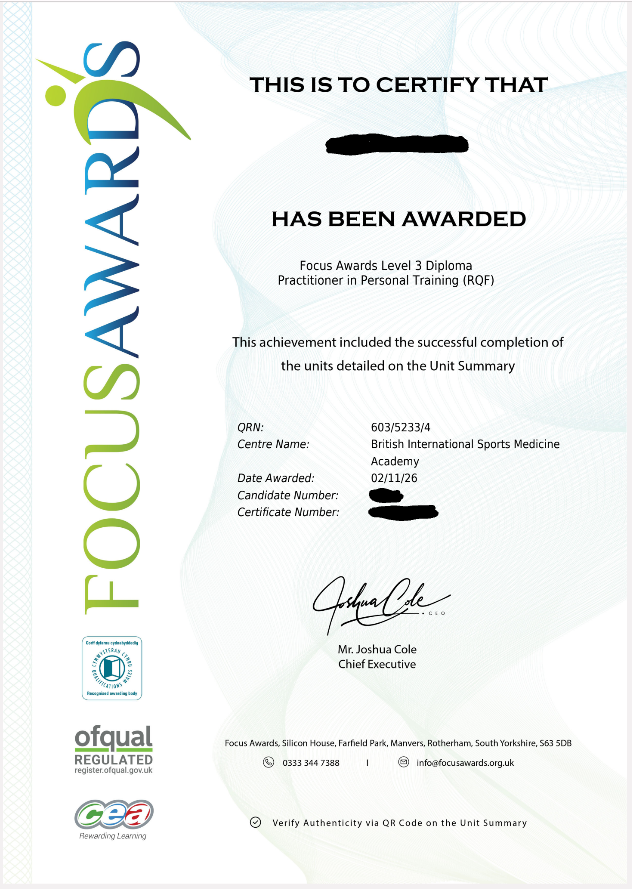
A genuine Level 3 Personal Training certificate will usually include the following details:
The qualification has to display the Ofqual logo at the certificate to confirm that this is an official UK regulated qualification.
The qualification level, such as Level 3.
The qualification title, such as Personal Training.
The name of the awarding body that issued the certificate.
The qualification number, also known as the RQF number or QRN.
The learner’s full name.
The certificate number or unique reference number.
The date the certificate was issued.
A verification feature, such as a QR code or online certificate checker.
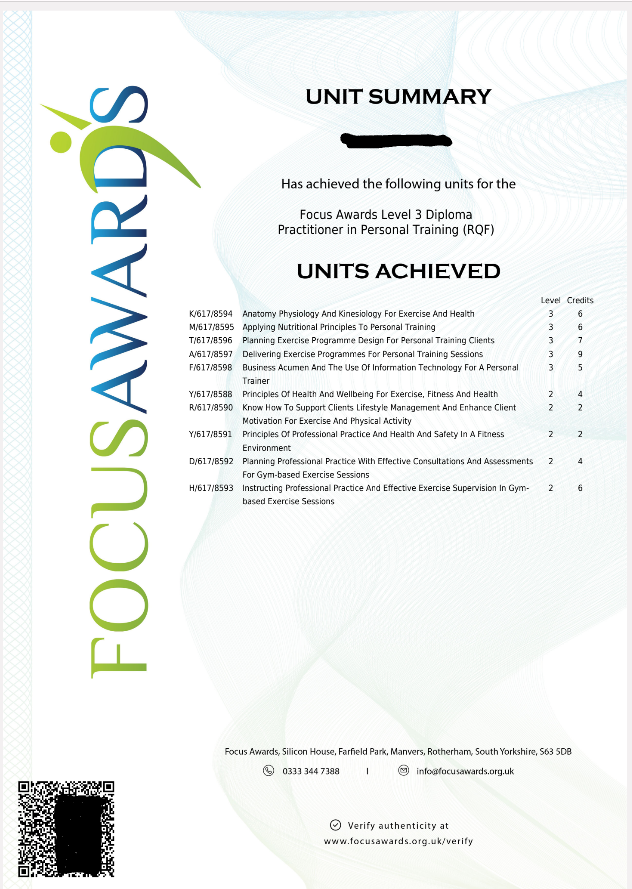
A unit breakdown, either on the main certificate or on a second certificate page.
Certificate Explainer

Unit Breakdown
Some Level 3 Personal Training certificates include a second page showing the full list of units completed by the learner.
This unit breakdown may include:
Unit titles.
Unit numbers.
The level of each unit.
Credits or guided learning hours, where applicable.
This information helps confirm that the qualification is a full Level 3 Personal Training qualification and not simply a membership certificate, short course, CPD course or unofficial training document.
Important Notice
This infographic and example certificate below are for general guidance only. Certificate layouts can vary depending on the awarding body. The names and elements are fictitious.
If you are unsure whether a certificate is genuine or whether it meets entry requirements for another qualification, you should check directly with the awarding body or the training provider that issued the certificate.
Example on how a certificate could look like (this is not a real certificate, it only contains the elements found in a certificate):

This is how your Certificate will look like when signing up for the Level 3 Diploma Practitioner in Personal Training.
Example Certificate:
Page 1 out of 2
Page 2 out of 2:
Policy
1. Purpose
The purpose of this policy is to clearly explain the procedures, responsibilities, and options available to learners who are unable to attend one or more scheduled face‑to‑face lessons as part of their course.
This policy ensures transparency and fairness while recognising that BISMA allocates specific resources, including venue hire, tutor allocation, and learner registration, for each scheduled face‑to‑face course date.
2. Course Registration and Commitment
When learners enrol on a course that includes face‑to‑face lessons, they are registering for specific scheduled lesson dates.
By enrolling, learners acknowledge and agree that:
- BISMA reserves and pays for venues, tutors, equipment, and other resources for each specific course date.
- Learners are registered to a specific course group and lesson schedule.
- These resources and registrations are allocated in advance based on confirmed learner enrolments.
- Attendance at face‑to‑face lessons is optional but strongly recommended to support learner progress and understanding.
3. Learners Unable to Attend a Scheduled Lesson
If a learner is unable to attend one or more scheduled face‑to‑face lessons, the learner may continue their course using alternative learning resources.
Learners can catch up on missed lessons by:
- Accessing the learner portal.
- Watching the video lessons covering the relevant unit(s).
- Reviewing course materials, manuals, and learner resources.
- Completing the required coursework and portfolio requirements.
BISMA provides comprehensive online resources to ensure learners can continue their learning without interruption.
4. No Obligation to Provide Alternative Lesson Dates
BISMA has no obligation to provide alternative lesson dates if a learner is unable to attend the scheduled lessons for non‑medical reasons.
This is because:
- Venues, tutors, and course resources are booked and paid in advance.
- Learners are registered for specific course dates and groups.
- Alternative attendance requires transferring the learner to a different course group, subject to availability.
5. Medical Exceptions
Exceptions may be made in cases of genuine medical reasons.
If a learner is unable to attend due to a medical condition, BISMA may allow a transfer to an alternative lesson date without the standard transfer fee, provided that:
- The learner provides a valid doctor’s letter or medical certificate.
- The medical document confirms that the learner was unable to attend the scheduled lesson due to a medical condition.
- The request is submitted within a reasonable timeframe.
- Availability exists in an alternative course group.
BISMA reserves the right to verify medical documentation.
6. Transfers for Non‑Medical Reasons
Learners who miss a lesson due to non‑medical reasons may request to attend the missed lesson with a different course group.
Requests must be submitted via email to:
Transfers are subject to:
- Availability of space in another course group.
- Approval by BISMA administration.
Transfers are not guaranteed.
7. Transfer Fees
A transfer fee applies when learners request to attend missed lessons on alternative dates for non‑medical reasons.
The current transfer fee is:
£50 per transfer per lesson day
Examples:
- If a learner misses 1 lesson and requests to attend that lesson with another course group:
- Transfer fee: £50
- If a learner misses 2 lessons and requests to attend both lessons with another course group:
- Transfer fee: £100 (£50 per lesson day)
Each lesson day requires a separate transfer and transfer fee.
8. Availability and Limitations
All transfers are subject to:
- Available space in alternative course groups
- Tutor Availability
- Venue capacity
- Administrative approval
If no availability exists, the learner must continue the course using the learner portal resources.
9. Learner Responsibility
Learners are responsible for:
- Attending the scheduled course dates they enrolled on
- Informing BISMA as soon as possible if they cannot attend
- Using the learner portal to catch up on missed content
- Paying applicable transfer fees when requesting transfers for non‑medical reasons
10. Contact Information
For transfer requests or enquiries, please contact:
Email: admin@bisma.org
Website: www.bisma.org
British International Sports Medicine Academy (BISMA)
BISMA — Corporate Sponsorship & Certification Policy
1. Purpose of this Policy
This policy sets out how BISMA (British International Sports Medicine Academy) manages corporate-sponsored learners, communication, data protection, payments, and certification for Ofqual-regulated qualifications (including Level 2 Fitness Instructor and Level 3 Personal Trainer).
It applies where a company (the Sponsor) funds or gifts a course to an individual employee (the Learner).
2. Parties to the Agreement
For the purposes of training and certification:
- The Sponsor (Company) is the financial contracting party responsible for payment.
- The Learner (Employee) is the academic and qualification holder.
This distinction is essential to comply with UK law, Ofqual expectations, and awarding body requirements.
3. Enrolment and Contractual Basis
3.1 Corporate enrolments must be completed using BISMA’s Third-Party / Corporate Course Form.
3.2 By signing the form:
- The Sponsor agrees to BISMA’s Terms and Conditions, Refund Policy, and Payment Terms.
- The Learner agrees to BISMA’s Learner Policies, Code of Conduct, and Assessment Requirements.
3.3 The course is considered a gift from the Sponsor to the Learner, unless otherwise stated in writing.
4. Communication
4.1 BISMA will communicate directly with the Learner regarding:
- Course access and learning materials
- Assessments and feedback
- Certification updates
- Attendance and progress
- Administrative queries relating to learning
4.2 Communication may take place via:
- Learner’s work email, or
- Learner’s personal email
4.3 The Learner may change their preferred email address at any time by notifying BISMA in writing.
4.4 BISMA may provide the Sponsor with:
- Confirmation of enrolment
- Confirmation of attendance
- Confirmation of pass or completion status
- A copy of the certificate (where appropriate)
However, BISMA will not share detailed academic feedback or personal data beyond what is necessary without explicit learner consent, in line with GDPR.
5. Certification and Certificates
5.1 Once the Learner has:
- Successfully completed all assessments,
- Met all academic requirements,
- Completed identity checks, and
- All outstanding fees are settled by the Sponsor,
BISMA will process certification in line with awarding body procedures.
5.2 Certificate Ownership
The qualification belongs to the Learner, not the Sponsor.
5.3 Certificate Issuance
BISMA will issue the official certificate in the Learner’s name.
5.4 Certificate Delivery
The Learner may choose for their certificate to be sent to:
- Their home address, or
- A business address (Sponsor’s address)
The Learner may change this delivery preference at any time prior to dispatch.
5.5 Sponsor Copy of Certificate
BISMA may provide the Sponsor with a copy of the certificate or written confirmation of achievement upon request.
5.6 Withholding of Certificates
BISMA may only withhold certificates for legitimate academic or administrative reasons, including:
- Outstanding payment
- Incomplete assessments
- Identity verification issues
- Breach of learner conduct policy
BISMA will not withhold certificates to enforce employment agreements, retention clauses, or HR disputes between the Sponsor and Learner.
6. GDPR and Data Protection
6.1 BISMA processes Learner data in accordance with UK GDPR and our Privacy Notice.
6.2 Lawful bases for processing include:
- Performance of a contract (training and certification)
- Legitimate interests (corporate sponsorship arrangements)
6.3 Data shared with the Sponsor will be limited to:
- Enrolment confirmation
- Attendance status
- Pass/fail status
- Certification confirmation
No sensitive personal data or detailed assessment feedback will be shared without explicit learner consent.
6.4 Learners have the right to:
- Access their personal data
- Correct inaccurate data
- Request deletion where applicable
- Change their contact details at any time
7. Payment Responsibilities
7.1 The Sponsor is responsible for full payment of the course in accordance with BISMA’s Terms and Conditions.
7.2 Failure by the Sponsor to make payment may result in:
- Suspension of the Learner’s access to materials, or
- Delay in certification processing.
7.3 The Learner is not personally liable for payment where the Sponsor has formally agreed to fund the course.
8. Withdrawal, Termination, or Employment Disputes
8.1 If the Learner leaves employment before completing the course:
- The Sponsor remains responsible for any agreed payment schedule unless otherwise stated in writing.
- The Learner may continue their studies independently if approved by BISMA.
8.2 BISMA will not intervene in employment disputes between the Sponsor and Learner.
8.3 BISMA will not:
- Withhold certificates as leverage in employment matters, or
- Act as an enforcement body for retention agreements.
9. Compliance with Ofqual and Awarding Bodies
BISMA delivers qualifications in compliance with Ofqual regulations and awarding body requirements. Where there is any conflict between employer requests and regulatory expectations, BISMA will follow regulatory requirements.
10. Acceptance of Policy
By enrolling a corporate-sponsored learner, the Sponsor and Learner both accept this policy in full.